
Spying on competition is the systematic process of tracking and analyzing your rivals’ marketing actions, pricing moves, and messaging shifts using publicly available data and automated tools. The industry term for this practice is competitive intelligence, and it is the foundation of every high-performing marketing playbook. Businesses that consistently monitor competitors are 3.2x more likely to achieve above-average growth rates. That number reflects a structural advantage, not luck. Companies that apply competitive intelligence also improve profit margins by 23% and accelerate product time-to-market by 18%. If you are a founder or marketer who wants to make faster, smarter decisions, building a competitor monitoring system is the highest-leverage move you can make this year.
What are the key areas to spy on competition?
Competitive intelligence covers six distinct data categories. Each one reveals a different layer of your rivals’ strategy.
- SEO keywords and rankings. The keywords a competitor ranks for tell you where they are winning organic traffic and which search intent they are targeting. Gaps in their keyword coverage are gaps you can fill.
- Paid advertising campaigns. Monitoring Google Ads and Meta Ads shows you which offers, hooks, and angles your rivals are spending real money to test. Ad creative shifts are one of the clearest signals of a strategic pivot.
- Website content and structural changes. A new landing page, a revised value proposition, or a reordered navigation menu all signal a change in positioning. These changes are easy to miss manually and easy to catch with automation.
- Pricing and product launches. Price changes and new SKUs reveal how a competitor reads market demand. A sudden price drop often signals inventory pressure or a push to capture market share.
- Social media and email campaigns. Engagement patterns on social posts and the cadence of promotional emails expose which messages resonate with a shared audience.
- Hiring signals and partnership news. A competitor posting five engineering roles in a new product category is a loud signal about where they are investing next. Partnership announcements reveal distribution and channel strategy.
Pro Tip: Set up a simple swipe file for competitor ads. Save screenshots of every ad you see from a rival brand, note the date, and tag the hook type. After 30 days, patterns in their creative strategy become obvious.
How do you set up automated competitor monitoring?
Manual monitoring does not scale. A structured, automated system is the only way to track rival activities across multiple channels without burning out your team.
Step 1: Define your target list. Select 3–5 direct competitors and 2–3 aspirational brands that operate in adjacent markets. Direct competitors share your audience and solve the same core problem. Aspirational brands show you where the category is heading.
Step 2: Build your tech stack. A complete monitoring stack combines four tool categories. You need an SEO platform for keyword and ranking data, a website change tracker for structural and copy updates, an ad intelligence platform for creative and campaign analysis, and a news alert system for press coverage and partnership announcements. Building a monitoring system that combines all four creates comprehensive market visibility that no single tool delivers alone.

Step 3: Configure alert thresholds. Raw data without filters creates noise, not intelligence. Set alerts only for changes that affect conversion-critical pages: pricing pages, homepages, and primary landing pages. Ignore blog post updates unless content strategy is a core focus of your analysis.
Step 4: Set your alert cadence. Automated systems can deliver alerts within 1–24 hours about pricing changes, new landing pages, and messaging updates. For high-stakes categories like pricing, configure alerts as close to real time as your tools allow. For content and social monitoring, a daily or weekly digest is sufficient.
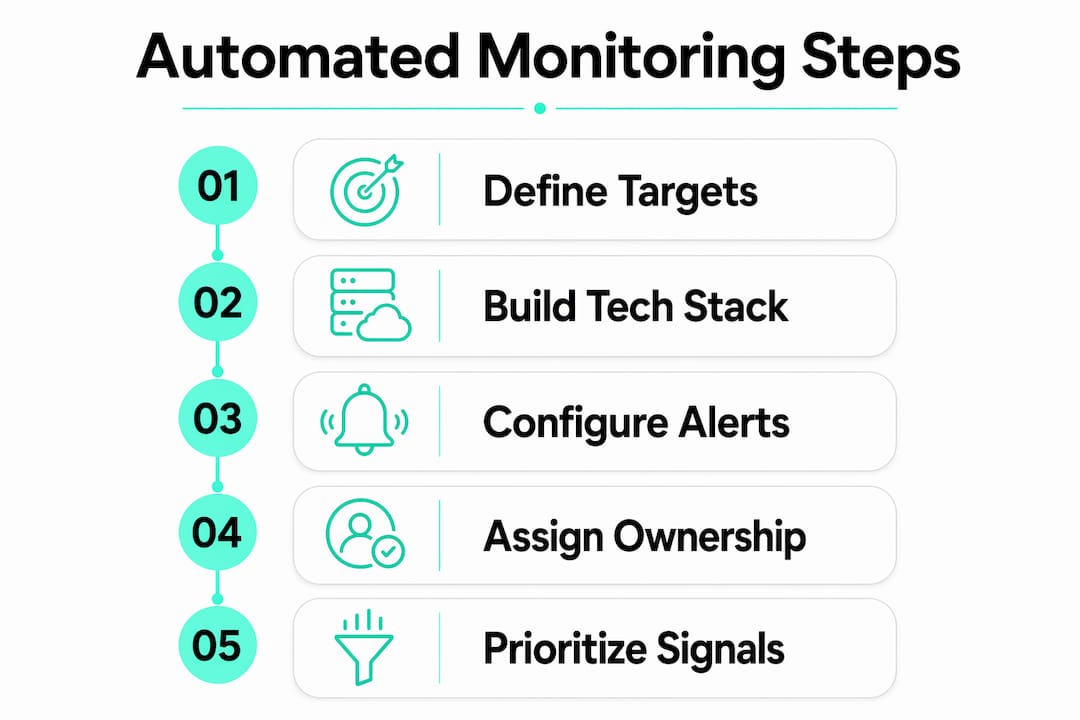
Step 5: Assign ownership. Every alert category needs one person responsible for reviewing and flagging items that require a response. Without ownership, alerts pile up and the system dies.
Pro Tip: Do not monitor everything at once. Start with pricing changes and new ad creatives. These two signals have the most direct impact on your conversion rate and campaign performance.
What are the ethical and legal boundaries of competitive intelligence?
Competitive intelligence is defined by its reliance on publicly available data. The practice is legal, ethical, and widely used by Fortune 500 companies and independent founders alike. The line is crossed when data collection involves deception, unauthorized access, or misrepresentation.
Permissible data sources include:
- Public websites, landing pages, and blog content
- Publicly visible ad libraries on Facebook, Google, and YouTube
- Job postings and LinkedIn company pages
- Press releases and public financial reports
- Customer reviews on platforms like G2, Trustpilot, and Amazon
- Social media posts and public engagement data
The U.S. Small Business Administration defines competitive analysis as a systematic evaluation designed to sharpen your positioning and inform your product roadmap, pricing, and messaging. That definition is grounded in open-source intelligence, not covert tactics.
What you must never do: access a competitor’s internal systems without authorization, pose as a customer to extract proprietary pricing or contract terms, or hire someone to steal trade secrets. Beyond the legal exposure, these tactics produce low-quality intelligence. Public data is more reliable because it reflects what a competitor actually wants the market to believe about them.
Ethical competitive intelligence also produces a sustainable advantage. You build a picture of the market based on real signals, not distorted data gathered through deception.
How do you turn competitive data into better marketing strategy?
Data collection and strategic interpretation are two different skills. Most teams are good at the first and weak at the second. Competitive analysis is a systematic evaluation, but its real impact only shows up when it changes your business decisions.
The first step is to separate monitoring from analysis. Monitoring is the ongoing collection of data points: new ads, pricing updates, keyword shifts. Analysis is the interpretive work of asking why a competitor made a move and what it means for your positioning.
Use structured frameworks to simplify comparisons
A mini-SWOT matrix applied to each competitor forces you to articulate their strengths, weaknesses, opportunities, and threats in concrete terms. A feature comparison matrix maps where your product leads, matches, or trails the field. These frameworks turn a spreadsheet of raw data into a clear picture of where you stand.
Find the whitespace, not the playbook
The most valuable output of competitor analysis is identifying what rivals are not doing. Underserved customer segments, feature gaps, and messaging angles that no one owns are where you build durable advantage. The copycat trap is the most common mistake in competitive intelligence. Copying a competitor’s hook or offer only works until they change it, and then you are always one step behind.
Integrate findings into your marketing workflow
Most competitive reports fail because they end as static documents with no connection to day-to-day decisions. The fix is to translate findings into three outputs: updated sales battlecards that address competitor objections, revised messaging that fills the whitespace you identified, and a prioritized test list for your next campaign cycle. Competitive intelligence that does not change what you ship next week is just research theater.
Key Takeaways
Competitive intelligence is the most direct path from market awareness to measurable growth, but only when it drives decisions rather than filling reports.
| Point | Details |
|---|---|
| Monitor six data categories | Track SEO, paid ads, website changes, pricing, social media, and hiring signals for full market visibility. |
| Automate with a four-tool stack | Combine SEO, website change tracking, ad intelligence, and news alerts to replace manual monitoring. |
| Stay within ethical boundaries | Use only publicly available data sources; avoid deception, unauthorized access, or misrepresentation. |
| Analyze the “why,” not just the “what” | Interpret competitor moves to find whitespace and inform your positioning, not to copy tactics. |
| Connect intelligence to decisions | Translate findings into sales battlecards, messaging updates, and a prioritized test list every cycle. |
The intelligence trap most marketers fall into
At Socialfuel, we see the same pattern repeat across agencies and eCommerce brands. A team sets up monitoring, gets excited about the volume of data coming in, and then spends more time reading competitor updates than shipping their own campaigns. The intelligence becomes the product instead of the input.
The fix is ruthless prioritization. Pricing changes and ad creative shifts are the two signals that most directly affect your conversion rate. Everything else is context. We have watched brands obsess over a competitor’s blog cadence while missing a pricing move that cost them a major account.
The other trap is treating competitive intelligence as a one-time project. Outdated analysis creates false confidence and actively harms decision-making. Markets shift, competitors pivot, and a six-month-old competitive report is often worse than no report at all because it gives you the illusion of knowledge.
The real value of a monitoring system is not the data it produces. It is the speed at which your team can respond to a market shift with a tested hypothesis instead of a gut reaction. Automate the collection, but keep a human in the loop for interpretation. The “why” behind a competitor’s move is never in the data. It is in the thinking you bring to it.
How Socialfuel helps you decode competitor ad strategy
Knowing what to monitor is one thing. Having a platform that surfaces the right signals automatically is another.

Socialfuel is an AI-powered ad intelligence platform built for marketers, agencies, and eCommerce brands. Search any brand, keyword, or URL to find winning Facebook, Instagram, Google, and YouTube ads. Save individual ads or full campaigns to decode the hook, angle, and creative structure behind them. Companies spending over $50,000 monthly on advertising refresh their creatives every 7–14 days to avoid creative fatigue. Socialfuel lets you track exactly when rivals rotate their creative and what they replace it with, so you can anticipate their next move instead of reacting to it. Start with Socialfuel and ship higher-converting campaigns faster.
FAQ
What does it mean to spy on competition?
Spying on competition, formally called competitive intelligence, is the practice of systematically collecting and analyzing publicly available data about rivals’ marketing, pricing, and positioning to inform your own strategy.
Is monitoring competitors legal?
Competitive intelligence based on publicly available data is fully legal. The practice becomes illegal when it involves unauthorized system access, deception, or theft of proprietary information.
How often should you monitor competitors?
Pricing and ad creative changes warrant near real-time alerts, while content and social media updates can be reviewed in a daily or weekly digest. Automated systems deliver alerts within 1–24 hours for the most critical signals.
How many competitors should you track?
Start with 3–5 direct competitors and 2–3 aspirational brands. Tracking more than eight competitors at once creates data overload and dilutes the quality of your analysis.
What is the biggest mistake in competitive intelligence?
The copycat trap is the most damaging mistake. Copying a competitor’s tactics without understanding the strategy behind them produces short-term imitation and long-term positioning confusion. Use competitor data to find whitespace, not to replicate what rivals are already doing.