TikTok ads are paid, native video advertisements that businesses use to reach targeted audiences directly inside the app. Yes, you can run ads on TikTok, but only through a dedicated business account. Personal profiles are ineligible. The platform’s self-serve TikTok Ads Manager gives any business, from a solo founder to a national brand, access to multiple ad formats, precise audience targeting, and flexible budgets. Account verification and ad review typically take 1–2 business days, so most marketers can go from zero to live campaign within a week.
What types of ads can businesses run on TikTok?
TikTok offers six core ad formats, and choosing the right one depends entirely on your budget and campaign goal. Each format sits at a different point on the visibility-versus-cost spectrum.
| Ad Format | How it appears | Starting budget | Best for |
|---|---|---|---|
| In-Feed Ads | Native video in the For You feed | $20/day (ad group) | Brand awareness, direct response |
| Spark Ads | Boosted organic posts | $20/day (ad group) | Social proof, community building |
| Search Ads | Keyword-targeted results page | $20/day (ad group) | High-intent capture |
| TopView | Full-screen on app open | Higher budget, reserved | Mass reach, product launches |
| Brand Takeover | Full-screen on app open, day-exclusive | Higher budget, reserved | Tentpole campaigns |
| Shopping Ads | Product catalog in feed and search | Varies | eCommerce, direct purchase |
In-Feed Ads blend into the For You page alongside user-generated content. They are the most accessible entry point because the ad group minimum is $20/day, and they do not require a connected TikTok profile to run.
Spark Ads work differently. They boost existing organic posts while keeping all engagement metrics, likes, comments, and shares, attached to the original post. That social proof compounds over time in a way standard In-Feed Ads cannot replicate.
Search Ads are the format most marketers overlook. TikTok Search Ads place keyword-driven ads inside TikTok’s search results, capturing users who are actively looking for something. The intent signal is strong, similar to Google Search, and the competition is still relatively thin compared to traditional search platforms.
Premium reservation formats like TopView and Brand Takeover deliver full-screen video the moment a user opens the app. These formats require higher budgets and advance booking. They suit large product launches or seasonal campaigns where maximum reach on a specific day matters more than cost efficiency.
Shopping Ads connect your product catalog directly to TikTok’s feed and search. They appear as image ads, video ads, and carousel formats across TikTok and its partner apps, making them the natural choice for eCommerce brands running product-level campaigns.
Pro Tip: If you are new to TikTok advertising, start with In-Feed or Spark Ads. Test your creative hooks at low spend before committing budget to premium reservation formats.
How to set up and run TikTok ads step by step
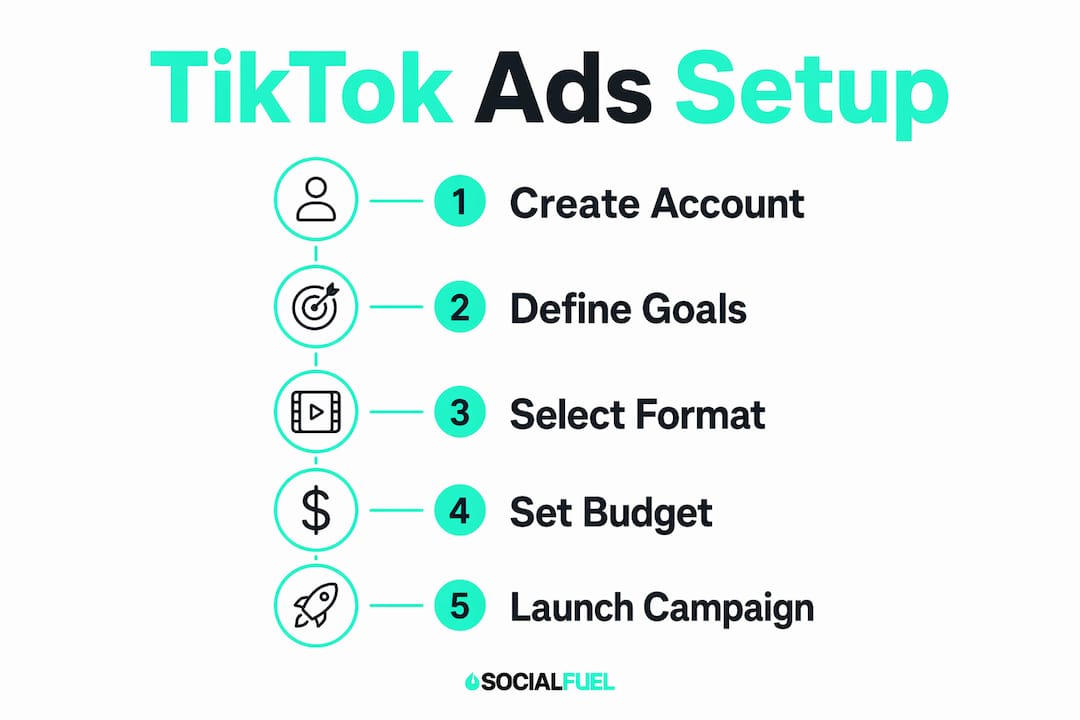
Getting your first campaign live requires completing a few setup steps in the right order. Skipping any of them creates problems later, especially around tracking and billing.
-
Create a TikTok Business Center account. Go to business.tiktok.com and register. The Business Center centralizes asset management, letting agencies and clients collaborate without sharing login credentials. This is the parent layer that holds everything else.
-
Set up an ad account inside Business Center. Add your billing information, select your currency, and choose your time zone. These settings cannot be changed after the account is created, so double-check them before saving.
-
Install the TikTok Pixel. Add the Pixel to your website before you launch any campaign. The Pixel tracks user actions like page views, add-to-cart events, and purchases. Pair it with server-side API tracking to recover data lost to ad blockers and browser privacy restrictions. This step is infrastructure, not optional.
-
Create your campaign. Inside Ads Manager, select your campaign objective, reach, traffic, conversions, or app installs. Set a campaign-level budget if you want a spending cap across all ad groups.
-
Configure your ad group. Define your audience by demographics, interests, and behaviors. Set your daily budget (minimum $20/day at the ad group level) and choose your bidding strategy. Lowest cost works well for most new campaigns.
-
Build your ad creative. Upload a vertical video (9:16 ratio, ideally 15–30 seconds). Write your ad copy, select a call-to-action button, and add your destination URL. TikTok’s creative guidelines require that the main message appears in the first 3 seconds.
-
Submit for review. TikTok reviews ads for policy compliance. Most ads clear review within 24 hours. Account-level verification also takes 1–2 business days on first setup.
Pro Tip: Name your campaigns, ad groups, and ads with a consistent convention from day one. When you are running five campaigns with three ad groups each, clear naming saves hours of confusion in reporting.
Can you use personal TikTok accounts for advertising?
Personal TikTok accounts cannot run ads. TikTok requires a business account and an active Ads Manager setup for any paid promotion. The distinction matters because it affects which ad formats are available to you.
Standard In-Feed Ads do not require a connected TikTok profile. You can run them with just an Ads Manager account, no public-facing TikTok page needed. This is useful for businesses that want to advertise on TikTok without building an organic presence first.
Spark Ads are the exception. Because they boost organic posts while preserving engagement, they require a linked TikTok account that owns the original post. You connect the account inside Ads Manager by generating an authorization code from the TikTok app. The process takes about two minutes.
The practical implication for businesses starting fresh:
- Run In-Feed Ads immediately with no TikTok profile required.
- Build an organic content library on a business TikTok profile if Spark Ads are part of your plan.
- Connect the profile to Ads Manager when you are ready to boost posts.
- Do not try to run ads from a personal account. TikTok’s system will reject the setup.
Pro Tip: Even if you plan to run only In-Feed Ads, create a TikTok business profile anyway. It gives you access to TikTok analytics, organic reach, and the option to run Spark Ads later without rebuilding your setup.
What are the best practices for TikTok ad campaigns?
The technical foundation of a TikTok campaign determines whether your data is reliable enough to make good decisions. Most wasted ad spend traces back to poor attribution setup, not bad creative.
Experienced advertisers treat the TikTok Pixel and server-side tracking as critical infrastructure. Neglecting this setup leads to lost conversion data, which makes it impossible to optimize delivery or prove ROI. Install both before your first campaign goes live.
Tracking and attribution:
- Install the TikTok Pixel on every page of your website, not just the homepage.
- Set up server-side API events to capture conversions that browser-based tracking misses.
- Verify that your Pixel fires correctly using TikTok’s built-in Pixel Helper tool before launch.
Budget and format strategy:
- Start with self-serve auction formats like In-Feed and Spark Ads to test creative at low cost.
- The campaign-level minimum budget is $50/day. Ad group minimums sit at $20/day.
- Reserve premium formats like TopView for campaigns where you have already validated your creative angle.
AI-driven optimization:
TikTok’s Smart+ Campaigns use AI-driven targeting to automate bidding, audience selection, and creative rotation. Smart+ reduces manual work and improves results by optimizing toward your stated campaign goal automatically. It is worth testing once you have enough conversion data for the algorithm to learn from, typically after 50 or more conversion events.
Creative and iteration:
- Shoot video in 9:16 vertical format. Horizontal video performs poorly on TikTok.
- Lead with your hook in the first 3 seconds. If the opening does not stop the scroll, nothing else matters.
- Rotate creatives every 2–3 weeks to avoid ad fatigue.
- Use TikTok Ads Manager’s analytics to track view-through rate, click-through rate, and cost per result. Drop underperformers fast and scale what works.
For deeper creative inspiration, the TikTok ad library is a practical starting point for benchmarking what formats and hooks competitors are running in your category.
Key Takeaways
TikTok advertising is accessible to any business willing to complete the setup correctly, but the technical foundation, especially Pixel and server-side tracking, determines whether your campaigns generate reliable data or just spend money.
| Point | Details |
|---|---|
| Business accounts only | Personal TikTok profiles cannot run ads; a Business Center account is required. |
| Multiple ad formats available | In-Feed, Spark, Search, TopView, and Shopping Ads each serve different goals and budgets. |
| Minimum budgets are low | Ad groups start at $20/day, making TikTok accessible for small businesses testing creative. |
| Tracking setup is non-negotiable | Install TikTok Pixel and server-side API before launching any campaign to protect conversion data. |
| Start small, then scale | Test creative with auction formats first; move to premium reservation formats only after validating your angle. |
The honest truth about TikTok ads in 2026
Most marketers I talk to make the same mistake: they obsess over creative and ignore the plumbing. They spend hours perfecting a 15-second video, then launch without a properly configured Pixel. Two weeks later, they have no idea which ad drove purchases, and they are optimizing blind.
The creative matters. But the tracking setup is what makes the creative learnable. Without clean data, you cannot tell a winning hook from a losing one. You are just guessing.
My honest take on format selection: start with Spark Ads if you have any organic content worth boosting. The social proof angle is real. A post with 10,000 likes that you put $500 behind converts differently than a cold In-Feed Ad with zero engagement. Audiences read those numbers, consciously or not.
On Smart+ Campaigns: I was skeptical of handing targeting control to an algorithm, but the results speak for themselves once you feed it enough conversion data. The key is patience. Let it run through the learning phase before you judge it.
For competitive intelligence, tools like Socialfuel let you decode the hooks, angles, and creative structures behind winning ads in your category. Knowing what is already working in your market cuts your testing time significantly. Check out ads insights that move the needle for a practical framework on reading competitor creative.
How Socialfuel helps you build better TikTok campaigns
Running TikTok ads without knowing what is working in your market is expensive. Socialfuel is an AI-powered ad intelligence platform built for marketers, agencies, and eCommerce brands who want to ship higher-converting campaigns faster.
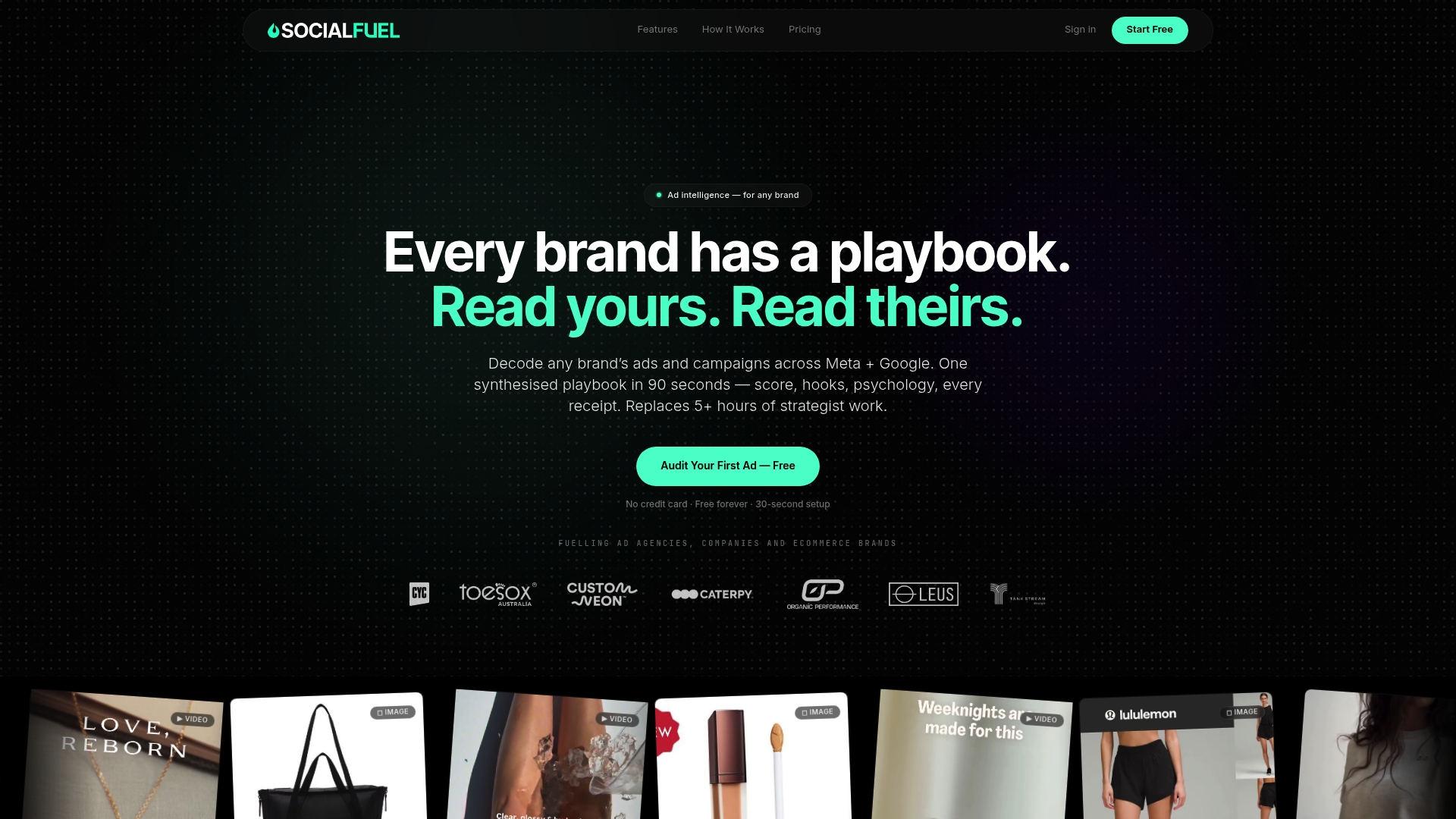
Search any brand, keyword, or URL to surface winning ad creative across TikTok, Facebook, Instagram, Google, and YouTube. Save individual ads or full campaigns, then decode the hooks, angles, and structures behind them. Use those findings to brief your creative team and build campaigns grounded in what already converts. Visit Socialfuel to start building your competitive playbook today.
FAQ
Can you run ads on TikTok without a business account?
No. TikTok requires a Business Center account and an active Ads Manager setup to run any paid advertising. Personal accounts are ineligible for all ad formats.
How much does it cost to advertise on TikTok?
The minimum ad group budget is $20/day, and the minimum campaign budget is $50/day. Premium reservation formats like TopView require higher budgets and advance booking.
Do TikTok ads require a TikTok profile?
Standard In-Feed Ads do not require a connected TikTok profile. Spark Ads do, because they boost existing organic posts and need a linked account to access that content.
What is the TikTok Pixel and why does it matter?
The TikTok Pixel is a tracking code you install on your website to record user actions like purchases and sign-ups. Pairing it with server-side API tracking prevents data loss from ad blockers and browser privacy settings, which is critical for accurate campaign optimization.
What are TikTok Search Ads?
TikTok Search Ads place keyword-targeted ads inside TikTok’s search results, capturing users who are actively searching for a topic. They function similarly to traditional paid search and are effective for reaching high-intent audiences.