
The TikTok ad library is an official transparency system that gives marketers direct access to ad creatives, targeting data, and advertiser identities running on TikTok. Most marketers treat it as a single tool. It is actually two separate platforms with different purposes, different data, and different geographic scopes. Knowing which one to use, and when, separates marketers who extract real intelligence from those who waste hours searching the wrong database. This guide breaks down both platforms, their limitations, and how to build them into a workflow that produces faster, sharper campaigns.
What is the TikTok ad library, and which platform should you use?
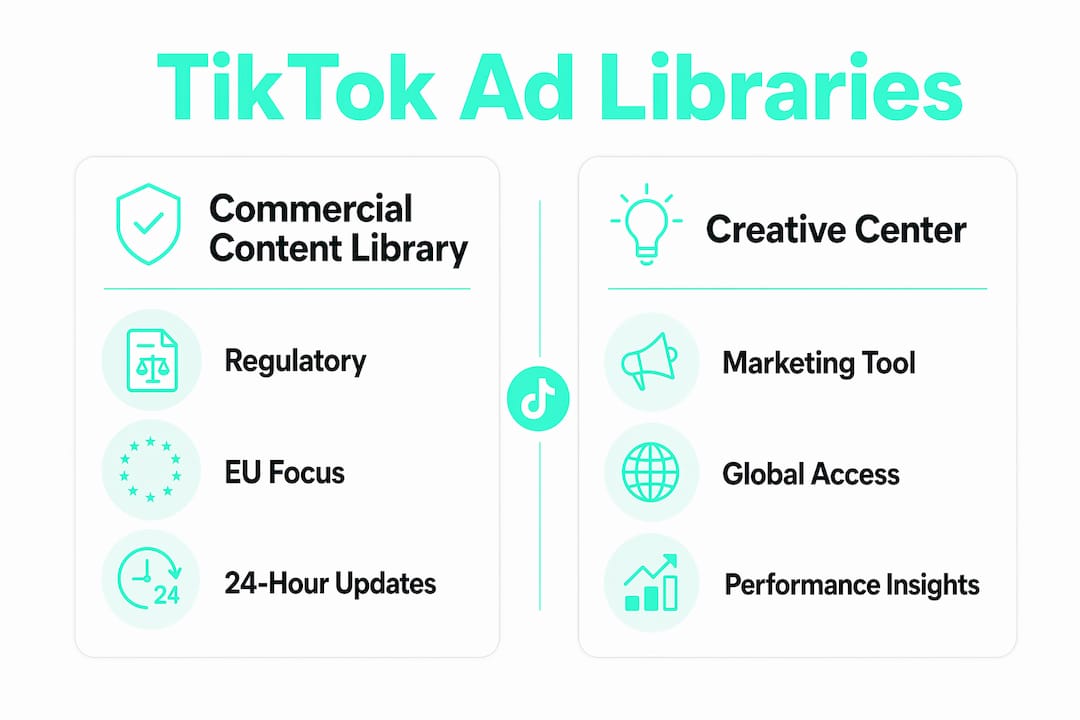
TikTok provides two distinct ad transparency platforms: the Commercial Content Library and the Creative Center. They look similar on the surface but serve completely different purposes. Mixing them up is the most common mistake marketers make when starting ad research on TikTok.
The Commercial Content Library is a regulatory archive. It was built to comply with the EU Digital Services Act (DSA) and covers ads served in the EU, UK, Switzerland, and Turkey. Every advertiser running in those markets must submit their ad data within 24 hours of going live. Non-compliance triggers fines of up to 6% of global annual turnover. That legal pressure means the data is thorough, timely, and mandatory.

The Creative Center is a global marketing tool. It has no regulatory requirement behind it. TikTok built it to help advertisers find inspiration, spot trends, and understand what formats perform well across different industries and regions. It covers far more countries than the Commercial Content Library but provides less granular targeting data.
| Feature | Commercial Content Library | Creative Center |
|---|---|---|
| Purpose | Regulatory transparency archive | Creative inspiration and trend research |
| Geographic scope | EU, UK, Switzerland, Turkey | Global |
| Targeting data | Yes: geo, age, interests, behavioral markers | No detailed targeting data |
| Advertiser identity | Disclosed | Disclosed |
| Data freshness | Updated within 24 hours | Trending ads updated frequently |
| Access | Free, public | Free; TikTok Business account unlocks more features |
| Best for | Competitive intelligence, audience research | Hook analysis, trend spotting, format benchmarking |
Pro Tip: If you are researching a brand that runs ads in the EU, start with the Commercial Content Library. If you want to find top-performing creatives globally, go straight to the Creative Center’s Top Ads dashboard.
How can marketers use TikTok ad data for competitive intelligence?
The Commercial Content Library provides granular targeting data at the audience segment level, including geography, age, gender, interests, and behavioral markers, without exposing individual user identities. That level of detail lets you reverse-engineer a competitor’s segmentation strategy with a precision that no other major platform currently matches.
Here is how to extract real competitive intelligence from both platforms:
- Decode competitor targeting angles. Search a competitor’s brand name in the Commercial Content Library. Review their active ads and note the audience segments they target. If a skincare brand consistently targets women aged 25–34 with interest in “clean beauty,” that signals a proven segment worth testing in your own campaigns.
- Identify winning hooks from the Creative Center. The Top Ads dashboard lets you filter by objective, industry, region, and date range as short as seven days. Watch the first three seconds of the top-ranked ads in your category. The opening line or visual is the hook. Catalog those hooks by type: question, bold claim, demonstration, or social proof.
- Track trending audio and hashtags. The Creative Center surfaces trending sounds and hashtags updated in near real time. Audio is one of TikTok’s most powerful creative levers. Pairing a trending sound with a strong visual hook significantly increases the chance of organic-style engagement on a paid ad.
- Monitor ad fatigue signals. Engagement signals like likes, shares, and comments visible in the Creative Center indicate ad vitality, but high engagement does not always equal high conversion. A video with massive shares might be entertaining rather than persuasive. Cross-reference engagement data with the ad’s call to action and destination URL before drawing conclusions.
- Watch A/B test variants. Because A/B tests become publicly visible within 24 hours of launch in DSA-covered markets, you can observe which creative variants a competitor is testing in near real time. That is an intelligence advantage most marketers have not yet figured out how to use.
Pro Tip: Filter the Creative Center by your specific industry and set the date range to the last seven days. Anything trending now reflects current audience behavior, not last quarter’s data.
What are the real limitations of TikTok’s ad research tools?
Understanding the constraints of these platforms saves you from building a research process on faulty assumptions. The limitations are real, and they affect what you can and cannot do.
-
Geographic restriction on the Commercial Content Library. The regulatory archive only covers ads served in the EU, UK, Switzerland, and Turkey. If your primary market is the United States, you will not find US-targeted ads in this database. The Creative Center partially fills this gap for creative research, but it does not expose targeting data for non-DSA markets.
-
No targeting data in the Creative Center. The Creative Center is built for inspiration, not intelligence. It shows you what ads look like and how they perform on engagement metrics, but it does not tell you who those ads targeted. For audience segmentation research, the Commercial Content Library is the only official source.
-
API access is gated. The official Commercial Content Library API is restricted to approved academic and non-profit researchers only. Commercial marketers cannot apply for access. The API is also rate-limited to approximately 1,000 requests per day, which limits scale even for approved users.
-
Manual research does not scale. Browsing either platform manually works for one-off research sessions. It breaks down when you need to monitor dozens of brands, track creative changes over time, or export data for analysis. The Commercial Content Library’s backend does communicate through JSON endpoints accessible without authentication, which enables some automation workarounds, but this requires technical knowledge most marketing teams do not have in-house.
-
Third-party tools fill the gap, but with trade-offs. Tools like Apify’s TikTok Ads Library Scraper extract structured data including metadata, video URLs, targeting information, and audience reach in JSON or CSV formats. These tools make large-scale research possible but add cost and require vetting for data accuracy and compliance with TikTok’s terms of service.
-
Teen targeting restrictions affect EU data. TikTok restricts personalized advertising to users aged 13–17 in the EU under 2026 regulations. Only contextual ads are permitted for that age group. This means the targeting data you see in the Commercial Content Library for EU markets reflects a constrained environment, not the full range of targeting options available elsewhere.
How to build TikTok ad library insights into your workflow
Ad library research only creates value when it connects directly to your creative and campaign process. Here is a workflow that turns raw data into faster, better-performing ads.
- Build a swipe file weekly. Set aside time each week to pull the top five ads from the Creative Center in your category. Save the hook, the visual format, the audio, and the call to action. Over time, this swipe file of ad elements becomes your creative DNA bank. You are not copying ads. You are cataloging what works so your team can generate original ideas grounded in proven patterns.
- Write briefs from real examples. Share swipe file entries directly with your creative team or designer. A brief that says “open with a bold claim like this, use this audio style, cut to product demo at five seconds” produces better output than a brief that describes a vague concept. Real examples remove ambiguity.
- Test fast and kill faster. TikTok’s algorithm rewards rapid iteration. Launch three to five creative variants based on different hooks you identified from the Creative Center. Give each variant enough budget to generate meaningful data, then cut the underperformers and scale what works. The top-performing ad formats shift quickly on TikTok, so a creative that wins this month may fatigue by next month.
- Align research cadence with data freshness. The Commercial Content Library updates within 24 hours. That means a competitor’s new campaign is visible to you almost immediately. Build a weekly competitive review into your calendar so you catch new angles before they saturate the market.
- Refine targeting from audience data. Use the audience segment data from the Commercial Content Library to pressure-test your own targeting assumptions. If a direct competitor consistently targets a segment you have ignored, that is either a gap in your strategy or a deliberate choice worth reconsidering. Either way, the data forces a decision rather than leaving it to guesswork.
Key Takeaways
The TikTok ad library is two separate platforms with distinct purposes, and using the right one for the right task is the foundation of effective ad intelligence.
| Point | Details |
|---|---|
| Two platforms, two purposes | Use the Commercial Content Library for targeting data and the Creative Center for creative inspiration. |
| Regulatory depth in DSA markets | The Commercial Content Library exposes targeting at the audience segment level for EU, UK, Switzerland, and Turkey. |
| API access is restricted | Official API access is limited to academic researchers; most marketers rely on manual research or third-party tools. |
| Swipe files accelerate creative | Cataloging hooks, audio, and formats weekly shortens the brief-to-launch cycle and grounds ideas in real performance data. |
| Engagement does not equal conversion | High likes and shares signal vitality, not profitability; always cross-reference engagement with the ad’s objective and destination. |
The part most marketers skip entirely
Most TikTok ad research guides tell you to browse the Creative Center, find some inspiration, and go make ads. That advice is not wrong. It is just incomplete.
The Commercial Content Library is where the real competitive intelligence lives, and most US-based marketers ignore it because it covers EU markets. That is a mistake. The brands running in the EU are often the same brands competing with you in the US. Their EU targeting data reveals their audience segmentation logic, their creative testing cadence, and the angles they are betting on. That intelligence transfers across markets even when the regulatory requirement does not.
The 24-hour disclosure window is also underused. When a competitor launches a new campaign, you can see it almost immediately. That is not just transparency. It is a live feed of their creative strategy. Marketers who check the library weekly are reacting to last week’s moves. Marketers who check it daily are watching the game unfold in near real time.
The strict API gating is a genuine constraint, and I will not pretend otherwise. Most teams do not have the technical resources to build automated pipelines from JSON endpoints. That is exactly why social media analytics tools that layer on top of TikTok’s public data have become so valuable. The raw data exists. The challenge is structuring it fast enough to act on it.
The marketers who win on TikTok in 2026 are not the ones with the biggest budgets. They are the ones who iterate fastest based on the freshest intelligence. The ad library gives you that intelligence. The question is whether you build a process around it or treat it as an occasional reference.
Ad intelligence that goes beyond TikTok’s native tools
TikTok’s native platforms give you a strong foundation, but they cover only part of the picture. Socialfuel extends that foundation across Facebook, Instagram, Google, and YouTube, so you can search any brand, keyword, or URL and see the full creative and campaign strategy behind their ads.
With Socialfuel, you can save individual ads or entire campaigns, decode the hooks and angles driving performance, and build briefs your creative team can execute immediately. The platform is built for marketers and eCommerce brands who need to move fast and make decisions based on real ad data, not assumptions. Start analyzing ads across every major channel and build campaigns that are grounded in what is actually working right now.
FAQ
What is the TikTok ad library?
The TikTok ad library refers to two platforms: the Commercial Content Library, a regulatory archive for DSA-covered markets, and the Creative Center, a global tool for creative research and trend discovery.
Is the TikTok ads library free to use?
Both platforms are free to access. The Creative Center unlocks additional features with a TikTok Business account, but the core ad search and filtering functions require no payment.
Can I use TikTok ad library data for competitor research in the US?
The Commercial Content Library covers EU, UK, Switzerland, and Turkey only. For US-market research, the Creative Center’s Top Ads dashboard is the primary official tool, though it does not expose targeting data.
How often does TikTok update its ad transparency data?
The Commercial Content Library updates ad data within 24 hours of an ad going live in DSA-covered markets. The Creative Center updates trending ads frequently but does not publish a fixed update schedule.
What is the best free TikTok ads spy approach?
The most effective free approach combines the Creative Center’s Top Ads dashboard for hook and format research with the Commercial Content Library for targeting intelligence in EU markets. Together, they function as a no-cost TikTok ads spy system with real regulatory-grade data.