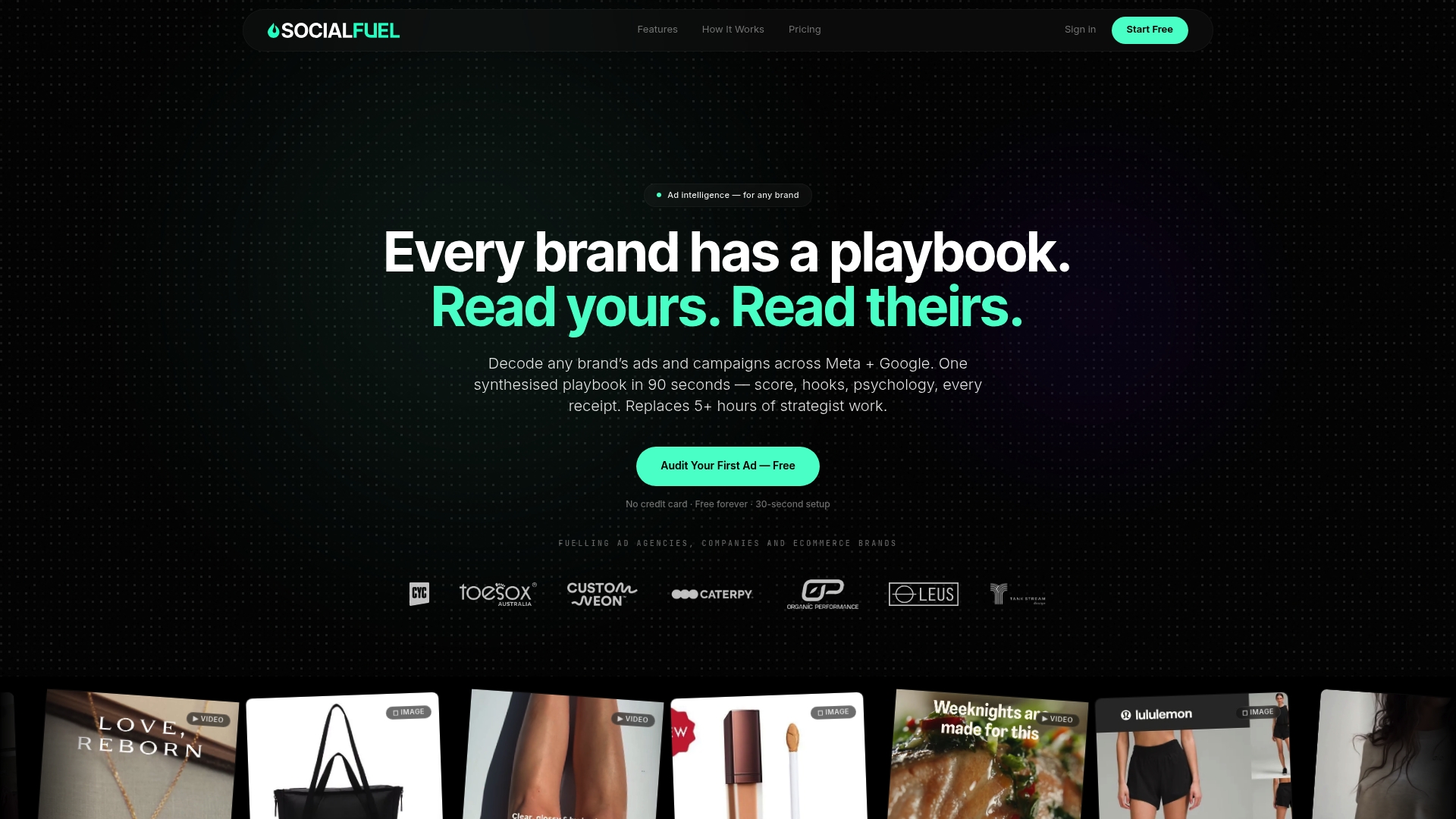
Tracking and comparing ad campaigns across social platforms, competitors, and markets demands more time than most in-house dashboards allow. Most “best social media analytics tools” miss live competitor ads and cross-platform creative trends, leaving critical gaps in research and reporting. This guide breaks down features, pricing, and network coverage in six ad intelligence tools so agencies and teams can choose options that fit real campaign needs.
Table of Contents
- SocialFuel
- AdSpyder
- Adsmom
- Intelobrand
- Benly AI Operating System for Performance Marketing
- AdsWizard
- Comparison of alternatives
SocialFuel
At a Glance
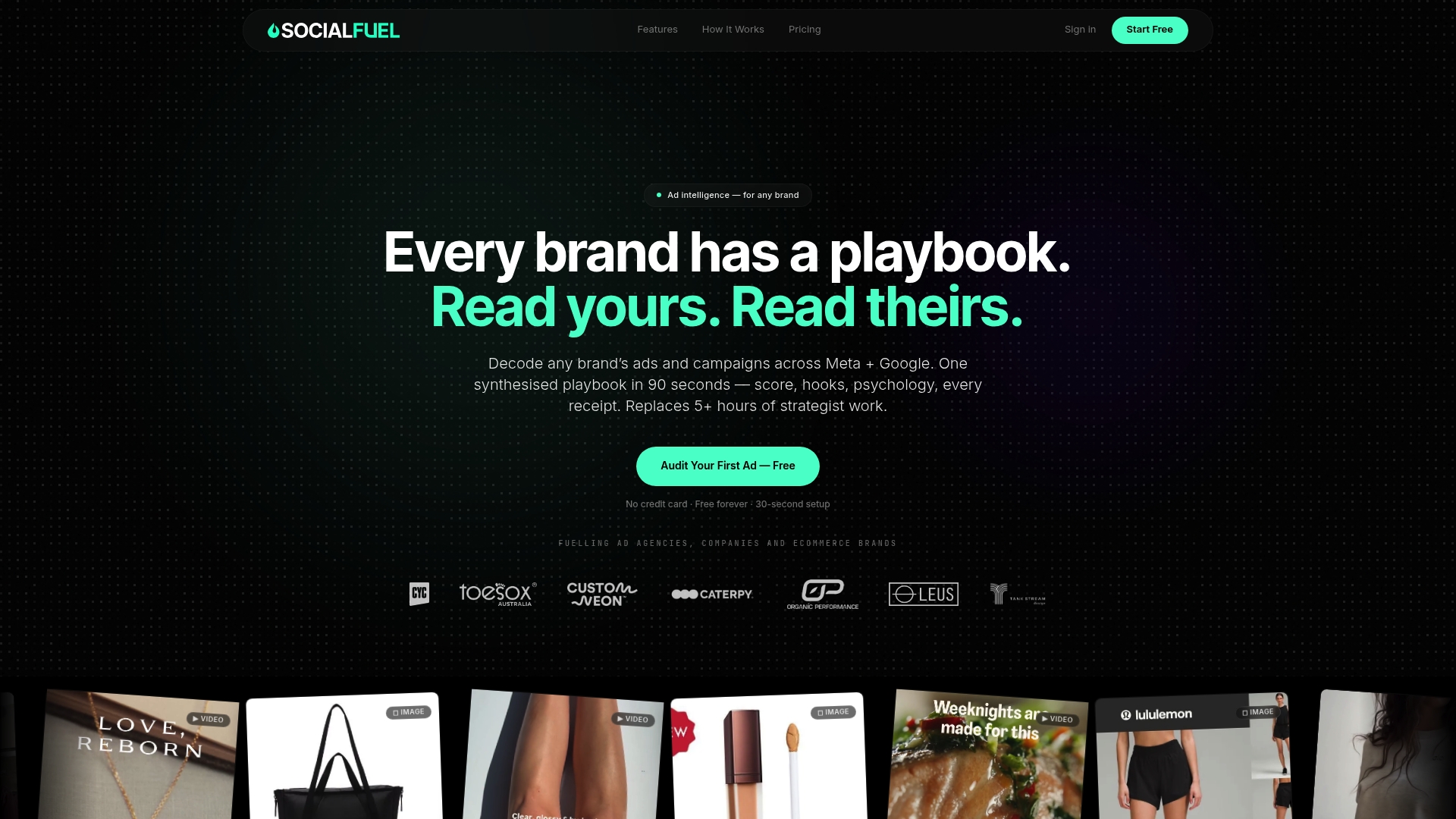
SocialFuel’s marketing materials state you can get a free audit of your first ad with a 30-second setup. The service focuses on Meta + Google ads and scores creative elements such as hooks, psychology, and receipts. It aims to cut research time for agencies and ecommerce brands by producing ready-to-use playbooks quickly.
Core Features
SocialFuel decodes campaigns across Meta + Google, parsing copy, creative, and landing receipts into searchable records and scored assessments. The vendor advertises generated playbooks in 90 seconds that synthesize competitor campaigns into a concise plan. The product also includes a free first-ad audit and a short onboarding flow aimed at ad agencies and ecommerce teams.
Key Differentiator
The primary differentiator is the automated playbook output, which turns campaign scraping and scoring into a single deliverable. That claim condenses several hours of manual competitive research into an executable brief for creative and media teams. Agencies can slot the brief directly into a competitive playbook or hand it to designers and copywriters as a guided creative brief.
Pros
The vendor claims it replaces 5+ hours of strategist work with synthesized playbooks and scored ad receipts. Free access with no credit card required, a free audit, and a short setup lower the barrier to testing competitor ad ideas. Support for multiple brands and campaigns helps teams build a searchable swipe-file and accelerate campaign planning.
Cons
- Covers Meta, Google, and TikTok, but not LinkedIn yet — so you’ll need another tool for LinkedIn campaigns.
Who It’s For
This fits ad agencies, ecommerce brands, and marketing teams that need fast competitor intelligence without heavy upfront cost. If you run tight creative sprints or lack senior strategist hours, the quick audits and playbooks help prioritize tests. For enterprise launches requiring deep bespoke research, plan to pair SocialFuel with manual strategy work.
Unique Value Proposition
Free first ad audit with no credit card required removes friction for teams trialing competitive analysis. Combined with automated playbook output, this reduces prelaunch research spend and speeds the path from insight to creative execution. For agencies billing by deliverable, the workflow cuts time between research and production and clarifies designer and copy briefs.
Real World Use Case
A marketing team used SocialFuel to decode top competitors’ Meta campaigns and generate playbooks that guided new creative. They prioritized headline and creative angles from scored receipts and launched A/B tests based on those briefs. The team reduced manual research hours and shipped clearer hooks to their creative partners.
Website: https://socialfuel.io
AdSpyder
At a Glance
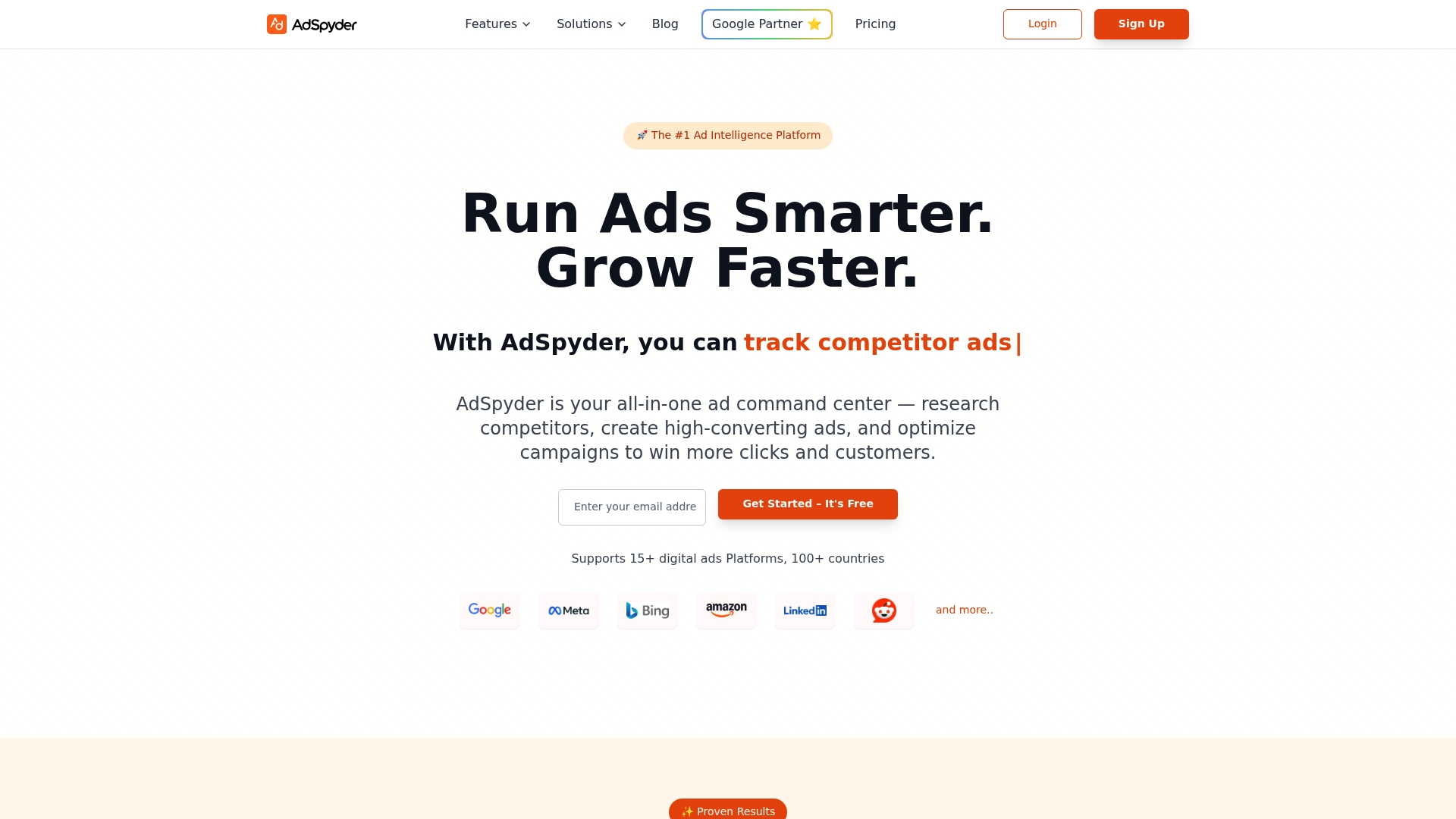
Over 15 ad platforms and coverage in more than 100 countries power AdSpyder’s ad library and competitive feed. That breadth lets agencies spot regional creative trends and cross platform campaign moves without hopping between separate tools. The platform also bundles AI driven creative generation and live campaign tracking in one interface.
Core Features
AdSpyder combines a live ad library with PPC keyword research and domain level competitor tracking, plus landing page inspection and trend analysis. The suite includes AI powered ad generation for text, image, and video creatives so you can prototype variants quickly. Real time monitoring and industry specific filters help teams focus on the platforms and markets that matter.
Key Differentiator
AdSpyder centers on broad multi platform discovery and built in creative production inside a single workflow. Its strength is the mix of real time ad creatives, keyword and domain signals, and AI powered ad generation, all visible in one interface. Compared with Socialfuel, AdSpyder aims at wider platform coverage and in product creative output rather than a deep archive limited to a handful of networks.
Pros
The product groups multi platform ad research and competitor benchmarks in one place, which reduces context switching for teams measuring campaigns across networks. Its AI creative tools let you generate draft headlines, image ideas, and short videos fast, saving briefing time. Real time monitoring and industry filters make tracking competitor shifts and keyword trends easier for agencies running many clients.
Cons
- Data granularity varies by region. Some markets show sparser creative examples.
- Pricing tiers may strain small businesses or solo practitioners, especially at higher feature levels.
- The feature set is broad and can be complex; new users may need time or training to use advanced reports.
When It May Not Fit
If your shop only needs deep archives for a single network or prefers a simpler dashboard, AdSpyder may feel overbuilt. Small in house teams or solo consultants with tight budgets might find the higher tiers too costly. If your priority is ultra granular local data in specific countries, coverage gaps could be limiting.
Who It’s For
Digital marketers, mid size agencies, and eCommerce brands that run ads across many networks and need both research and creative output will get the most value. The platform suits teams that can invest time in a full feature set and that benefit from combined monitoring and ad production in one tool.
Real World Use Case
An agency monitors a competitor set across Facebook, Google, and programmatic channels, spots a rising creative angle in one country, then uses the AI tools to generate three headline and image variants. The team tests the variants, refines copy with keyword insights, and updates landing page calls to improve CTR.
Pricing
Most plans start at $10/month, with higher tiers offering unlimited searches, agency features, and brand protection up to $99/month. Larger plans add expanded search limits and advanced monitoring geared to agencies and brands.
Website: https://adspyder.io
Adsmom
At a Glance
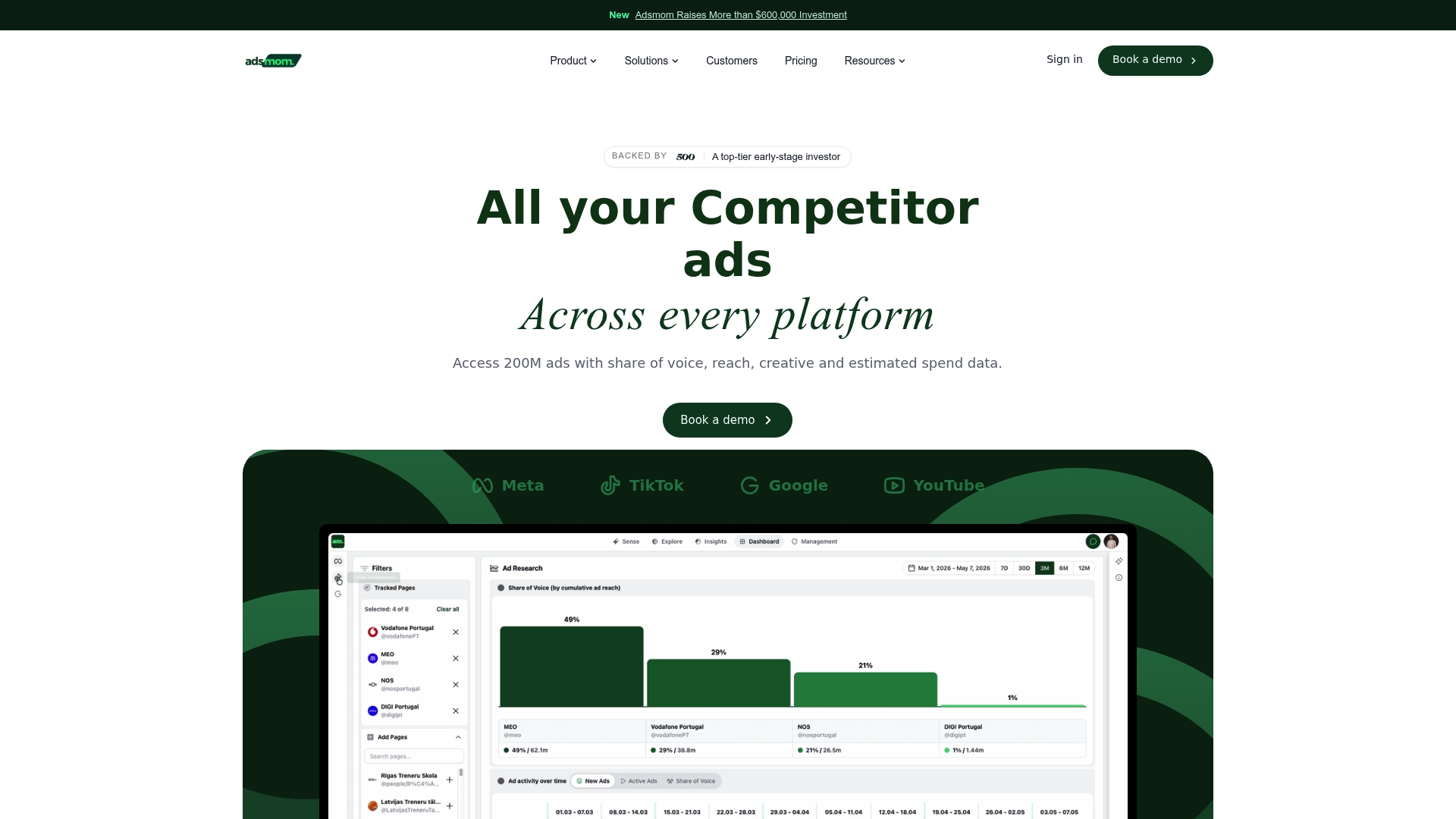
Adsmom reports access to 200M+ ads spanning Meta, TikTok, Google, and LinkedIn. That index updates daily and powers alerts for campaign launches, spend shifts, and creative changes. The platform targets teams that want fast competitive signals without manual scraping.
Core Features
Adsmom collects and indexes ads across major social and search platforms while offering search, filters, and saved collections for deeper review. The platform delivers real time daily updates, automated benchmarking reports, and AI driven creative analysis to surface patterns in messaging and targeting. Users can pull data via API and set custom alerts for competitors or creative changes.
Key Differentiator
Adsmom’s main edge is its unified, real time ad index combined with AI driven analysis across networks. That combination lets you compare creative and spend moves side by side across otherwise siloed channels. The result is faster competitive reads for campaign planning and creative tests.
Pros
Adsmom gives a cross platform view of competitor ad activity, which reduces the need to check multiple ad libraries manually. The vendor advertises AI driven insights that summarize visual and targeting trends, saving analysts time when building a swipe file. Daily refreshes and alerting make it easy to react to new campaigns quickly, and API access supports integration with reporting stacks.
The product offers flexible subscription tiers and a 7 day free trial that helps teams validate fit before committing. Investors include 500 Global and EU development initiatives, which the company cites as part of its funding background. The interface emphasizes visual ad analysis and straightforward alert setup for busy media buyers.
Cons
- Some third party reviews report a learning curve when using advanced analysis features. This can slow onboarding for teams without dedicated analysts.
- The platform’s data volume can overwhelm very small teams or solo marketers who lack analytics resources. They may not use the full index.
- Pricing for higher tiers is steep for small businesses, making some advanced features effectively reserved for larger agencies or research teams.
- As with large ad indexes, occasional discrepancies can happen because of source API limitations.
When It May Not Fit
If you run a solo consultancy with limited budget and no analytics support, the platform’s volume and feature set may be more than you need. Teams focused only on organic content or community management will not benefit from the paid tiers that target paid ad research. Small brands with a strict cost ceiling may prefer a simpler, cheaper ad library tool.
Who It’s For
Adsmom suits growth teams, media buyers, and agencies that run multi platform paid campaigns and need competitive ad signals. Research analysts and market intelligence teams will value the historical index and API access for programmatic reporting. Solo freelancers may find more value during short trials than as a long term platform unless they scale their ad research.
Real World Use Case
An agency monitors competitor launches across Meta and TikTok and gets an alert when a rival increases spend on a new creative. The team saves the creative collection, extracts the targeting signals, and runs a split test within days. That workflow replaces hours of manual searching and helps the agency respond faster to competitors.
Pricing
Plans start at €75/month for the Basic plan. Business tier pricing begins at €450/month, and custom enterprise solutions are available for large organizations. A 7 day trial is offered so teams can evaluate the platform before committing to a paid plan.
Website: https://adsmom.com
Intelobrand
At a Glance
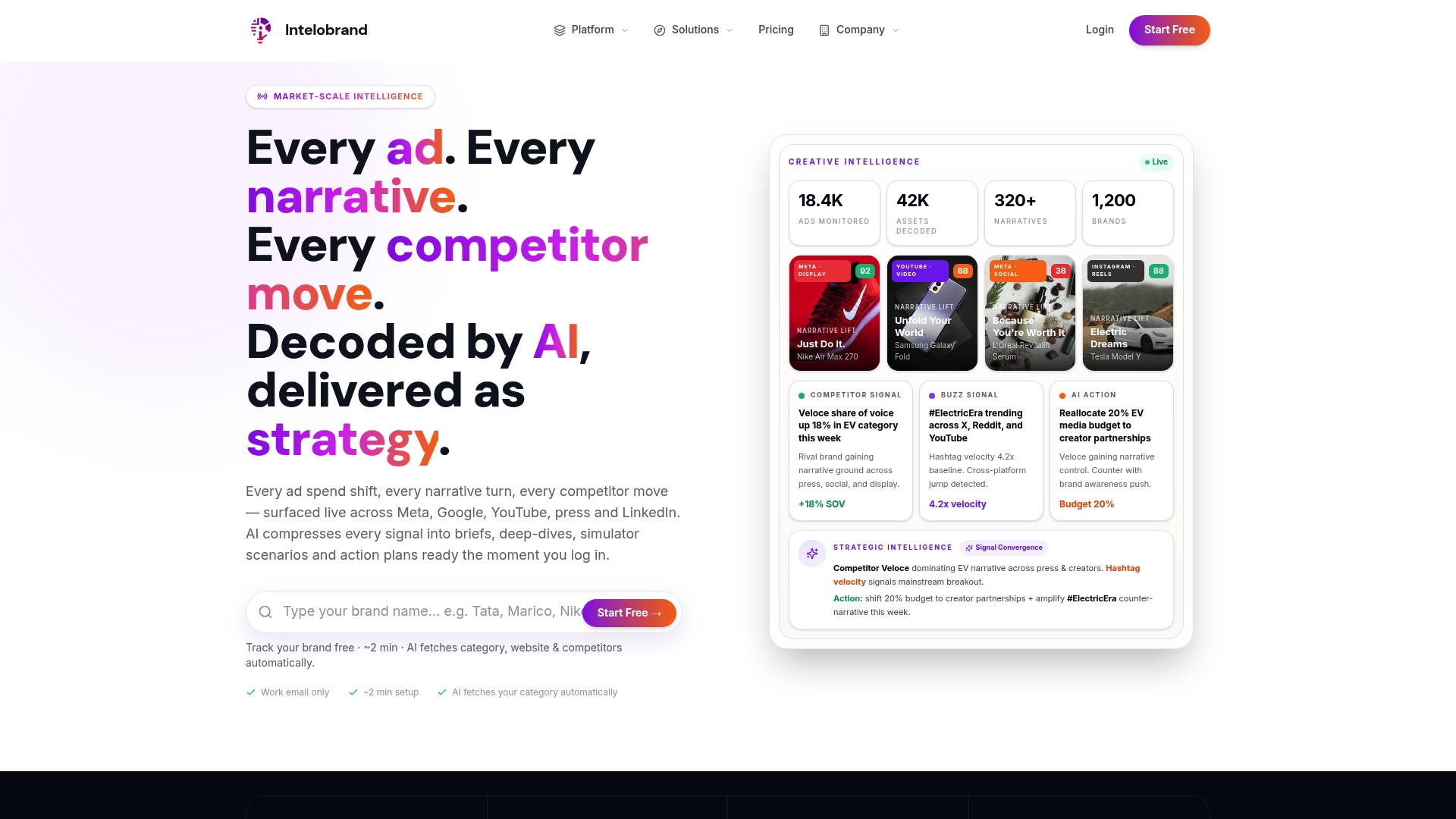
Intelobrand ingests market signals in real time from major ad platforms, press, and social media. The platform combines those live feeds with a connected historical baseline to reveal when a narrative or creative pattern deviates. That pairing helps teams spot emerging competitor moves and creative fatigue faster than single channel monitoring.
Core Features
Intelobrand collects real time market signals across ads, press, and social channels and stores them against historical baselines for trend analysis. Its creative analysis inspects visuals, text, and sentiment while automated narrative detection highlights shifts in public conversation. Predictive alerts warn teams about creative fatigue, market shifts, and narrative openings so marketers can respond quickly.
Key Differentiator
The product’s distinguishing angle is its blend of connected historical baselines with live, cross channel inputs, plus AI driven recommendations meant for strategic discussion. That combination makes it easier to measure whether a change is noise or a genuine shift relative to past market behavior. The result reads like a competitive playbook rather than an isolated report.
Pros
Intelobrand delivers continuous, multi channel market coverage that keeps teams aware of competitor moves and media shifts. Its historical data depth strengthens pattern recognition and supports longer term planning rather than short term guesswork. The interface targets marketers with practical recommendations ready to use in meetings, and the creative analysis combines visual and text signals so creative teams can iterate faster.
Cons
- Training can be substantive. Third party reviews suggest a learning curve for new users and for teams without a dedicated analyst.
- Pricing scales with brand volume and resource consumption. That model can be costly for large portfolios with many tracked properties.
- The platform’s breadth may overwhelm teams that lack onboarding or a clear tracking plan. Smaller teams risk paying for modules they do not use.
Who It’s For
Marketing teams, brand leaders, and agencies that need continuous market and creative intelligence will get the most value. The tool fits organizations that run multiple campaigns and require connected historical context to guide strategy. Digital first brands that track influencers, press, and ad creatives at scale will find the feature set aligned with their workflows.
Real World Use Case
A consumer brand used Intelobrand to monitor competitor advertising and detect an emerging narrative tied to product sustainability. The team received alerts and adjusted creative messaging within days, then tested new hooks against the historical baseline to confirm resonance. That workflow helped the brand maintain engagement while the competitor narrative gained traction.
Pricing
Pricing details are listed on the vendor site. The company lists multiple tiered plans and free trial options, with costs that scale by brand volume and resource consumption. Teams should review licensing terms for portfolio tracking and data retention limits.
Website: https://intelobrand.com
Benly AI Operating System for Performance Marketing
At a Glance
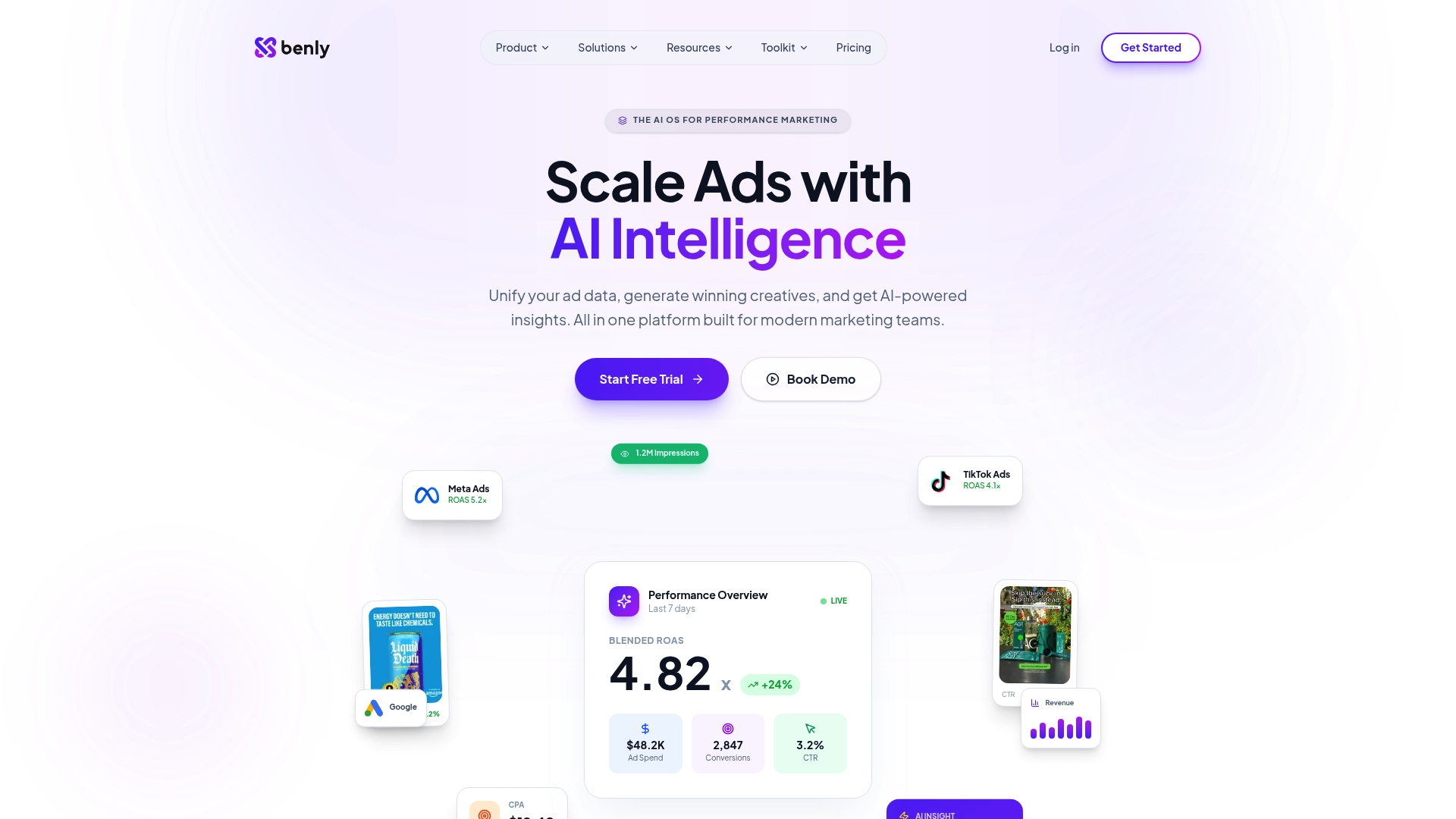
Starting at $99/month with no hidden fees and unlimited ad spend tracking makes cost predictable for teams juggling many client accounts. The platform combines creative generation, competitor ad research, and unified reporting under one roof. That price point and the multi user access aim to replace several separate subscriptions.
Core Features
Benly centralizes ad account data from Meta Ads, TikTok Ads, Google Ads, and GA4 and presents that data for query and reporting with an AI Copilot. The platform generates creative variations with an AI powered creative tool and detects visual patterns via Creative Vision to speed A B testing. An AdSpy style competitor library supports market research alongside scheduled reporting.
Key Differentiator
Benly’s defining angle is the combination of creative production and real time insights inside a single workspace. That integration links generated creatives directly to performance signals, so creative tests, reports, and competitor signals live in one place rather than in separate tools.
Pros
Benly positions itself as an all in one option that reduces the number of subscriptions agencies manage and shortens handoffs between creative and media teams. The AI creative generator speeds up variation testing while the Copilot lets non technical team members query performance in plain language. Support includes human account managers and the vendor emphasizes flat rate pricing with no hidden fees.
Cons
-
Relies on connected platform APIs. Some channels may not be supported and data syncs can lag.
-
Advanced AI creative features may add cost and require testing to validate return on ad spend.
-
The product is still under active development. Certain tools may exist in preview or evolve over time.
When It May Not Fit
If your campaigns run on niche or regional ad networks that Benly does not connect to, the platform will not capture that spend. Teams that need guaranteed instantaneous syncs should plan for occasional API delays. If you need built in billing or time tracking, Benly does not replace those specific tools.
Notable Integrations
- Meta Ads
- TikTok Ads
- Google Ads
- GA4
Who It’s For
Performance marketing teams and creative agencies running Meta, TikTok, and Google campaigns will find the platform useful. In house digital marketers managing multiple channels can reduce manual reporting overhead. The product targets teams that want AI assisted creative testing and unified performance dashboards.
Real World Use Case
An agency connects all client ad accounts to Benly, then uses the creative generator to produce multiple ad variations for new launches. The Copilot surfaces campaign performance trends in plain language and the team pulls daily reports for client updates. That workflow reduces manual exports and speeds creative iteration.
Pricing
Plans start at $99/month for Starter, move to $199/month for Boost, and $499/month for Scale, with custom Enterprise options available. Each plan advertises full feature access and the vendor states there are no hidden fees.
Website: https://benly.ai
AdsWizard
At a Glance
AdsWizard reports full access to international advertising data since 2023. That claim signals broad historical coverage across platforms. The platform emphasizes international advertising data as a foundation for competitive analysis. Readers should treat the timeline and coverage as vendor-reported.
Core Features
AdsWizard collects real-time competitor ad tracking across Meta, Google Ads, TikTok, YouTube, and Amazon and presents it in searchable listings. Proprietary AI models classify creative, index messaging, and flag investment shifts while automated reports export campaign snapshots for teams. Market trend detection and investment analysis tools help editorial teams pull trending creative angles and investment flows quickly.
Key Differentiator
The vendor advertises that its AI is the only one trained on the entire digital advertising landscape. That claim frames the product as focused on broad, cross-channel ad classification and messaging analysis. If accurate, that training would let the comparison data surface uncommon ad formats and cross-platform creative patterns not visible in smaller datasets.
Pros
AdsWizard aggregates cross-platform ad activity and groups examples into searchable listings, which makes competitive playbooks easier to build. Its proprietary AI models tag messaging and creative elements, reducing manual cataloging for editorial teams and researcher workflows. The platform offers automated reporting and high-speed analysis, which helps small teams produce regular competitive reports without heavy manual effort. The vendor also highlights enhanced data privacy and security as part of the platform design.
Cons
-
Limited information on specific integrations or deployment options. Buyers must confirm connectors and export formats before committing.
-
Pricing is presented in a basic way with starting figures, but detailed tier descriptions are not published. That makes precise budgeting difficult.
-
The comparison focus is digital advertising only. Offline channels and non-digital marketing receive little to no coverage.
-
Buyers should verify data coverage for the exact markets they need, since coverage depth varies by region.
When It May Not Fit
Organizations that run predominantly offline campaigns will find limited value. Agencies that require built-in connections to bespoke martech systems may struggle because integrations are not clearly documented. Small teams with tight budgets should ask for a full pricing breakdown. Enterprises that need guaranteed regional coverage should confirm sample data before purchase.
Who It’s For
Advertising professionals, marketing agencies, and media networks that require broad competitive ad listings and creative benchmarking will get the most from AdsWizard. Editorial teams and campaign strategists who rely on regular competitive reports will appreciate the automated exports and classification. Buyers focused on non-digital channels or needing deep martech integrations should look elsewhere.
Real World Use Case
A consumer brand marketing team monitors competitor campaigns across social and search to detect when rivals scale spend on a new creative angle. The team uses AdsWizard listings to build a swipe-file of creative hooks and then exports a weekly report for budget allocation. The reports feed media planning sessions and help the team reallocate spend within 24 hours of detecting a trend.
Website: https://adswizard.com
Comparison of alternatives
Marketing teams and ad agencies often prioritize tools that minimize manual efforts while maximizing insights for campaign strategies. Here is an analysis of key comparative factors across leading competitors in social media ad intelligence solutions, providing clarity on their applications and strengths relative to each other.
Scalability of platform coverage
AdSpyder stands out by supporting over fifteen ad platforms with extensive regional coverage. This capability provides marketing teams with access to diverse campaign data across platforms such as TikTok and LinkedIn. Compared to SocialFuel, which covers Meta, Google, and TikTok ads, AdSpyder offers broader coverage but at a costlier price point. Teams handling campaigns focused on multiple platforms may find AdSpyder’s capabilities compelling for research and execution.
Automation and depth of insights
SocialFuel’s primary distinction lies in its ability to synthesize playbooks from gathered campaign data within 90 seconds. This feature appeals directly to agencies constrained by time and bandwidth who need precise insights tailored to guide their creative processes. While other platforms offer similar features, SocialFuel achieves a balance between ease of use and insightful outputs, positioning it favorably for specific use cases involving rapid content readiness.
Best fit
- Marketing teams prioritizing automation and rapid insights will benefit most from SocialFuel’s 90-second playbook feature.
- Agencies managing campaigns across multiple platforms will appreciate the broad coverage provided by AdSpyder.
- Analysts focusing on integrated market signals should explore Intelobrand’s cross-channel baseline tracking.
- Organizations seeking cost-effective solutions for higher campaign thresholds might find Benly’s pricing structure and feature set advantageous.
Our pick
SocialFuel excels in automating competitive insight generation, making it a prime choice for capabilities not prioritized by its competitors. Specifically, the rapid synthesis of playbooks in mere seconds makes it for agencies and teams needing fast, insightful deliverables.
Select the best ad intelligence software by comparing platform coverage, pricing, and unique capabilities for your campaign research needs.
| Product | Platforms Covered | Key Differentiator | Best For | Pricing | Limitation |
|---|---|---|---|---|---|
| Socialfuel | Meta, Google, and TikTok ads usage | Fast automated playbook output and ad auditing | Agencies and eCommerce brands | Price not published | No LinkedIn support yet |
| AdSpyder | 15 platforms, 100 countries | AI-driven creation tools and real-time tracking | Digital marketers and mid-size agencies | $10–$99/month | Complexity in interface for new users |
| Adsmom | Meta, TikTok, Google, LinkedIn | Comprehensive ad index with daily updates | Growth teams and media buyers | €75–€450/month | Learning curve for advanced analysis features |
| Intelobrand | Ads, press, social media | Predictive narrative detection and historical baselines | Marketing teams and strategists | Price not published | Requires training effort for effective use |
| Benly AI | Meta, TikTok, Google, GA4 | Unified creative production and reporting | Creative agencies and marketers | $99–$499/month | Reliant on connected platform APIs for data sync |
| AdsWizard | Meta, Google, TikTok, Amazon | Broad cross-platform advertising analysis | Advertising professionals | Price not published | Limited offline channel coverage |
How to Get Clear Competitive Insights Without Spending Hours on Research
Identifying winning social media strategies can feel daunting when you need fast, reliable intelligence on ads across platforms like Facebook, Instagram, Google, and YouTube. Marketers, agencies, and ecommerce brands often waste valuable time gathering creative hooks, angles, and campaign insights manually.
Socialfuel tackles this by delivering quick, AI-powered ad audits and playbooks that decode competitor campaigns and highlight what works best. The platform lets you build a swipe-file of top-performing ads, analyze their components, and guide your design and copy teams with precise briefs.
Experience the power of Socialfuel to reduce hours of research into minutes. Try a free audit of your first ad and get a clear plan to launch higher-converting campaigns faster.
FAQ
How does Socialfuel help agencies improve their competitive intelligence?
Socialfuel generates automated playbooks that condense hours of manual competitive research into concise deliverables. It offers a free first-ad audit and a quick setup process that helps agencies optimize their ad campaigns effectively. Agencies can expect faster insights and actionable strategies right from the start.
What is the difference between Socialfuel and AdSpyder?
AdSpyder excels in broad multi-platform discovery and built-in creative production in a single workflow. Socialfuel, on the other hand, specializes in automated playbook outputs that directly link campaign scraping to actionable briefs, which benefits teams focused on quick implementation without juggling multiple tools.
Can I use Socialfuel for ad campaigns outside of Meta, Google, and TikTok?
Socialfuel covers Meta, Google, and TikTok ads. LinkedIn isn’t supported yet, so if your campaigns rely on LinkedIn you may need an additional tool alongside Socialfuel to cover that platform.
Which platform provides quicker access to ad performance insights?
Socialfuel provides quick playbooks that synthesize competitor campaigns in 90 seconds. This efficiency is ideal for teams needing to act swiftly on competitor data without extensive downtime. You can expect a streamlined reporting process to facilitate rapid decision-making.
How does Socialfuel’s pricing compare to other ad intelligence tools?
Socialfuel offers a free first-ad audit and a cost-effective entry point with no credit card required for trialing its features. This pricing model allows teams to evaluate the tool without immediate financial commitment, making it attractive for those exploring new options in ad intelligence.