
Kickstarter ads are paid promotions designed to build a warm, engaged audience before your campaign launches and convert that interest into real backers once it goes live. The most successful crowdfunding campaigns treat advertising not as an afterthought but as the engine behind early momentum. Paid ads accelerate organic growth in ways that organic reach alone cannot match, especially when Kickstarter’s strict deadlines leave no room for slow audience building. If you’re a founder or creator planning your next campaign, this guide covers every layer of a winning ad strategy, from timing and creative to targeting and budget.
1. When to start running Kickstarter ads
Timing is the single most underestimated factor in crowdfunding ads. The industry standard is clear: begin pre-launch marketing 8–12 weeks before your campaign goes live. That window gives you time to build an email list, warm up audiences, and test creative before you spend serious money.
Starting early matters because cold audiences rarely convert on first contact. You need multiple touchpoints before someone is ready to pledge. Pre-launch ads that drive traffic to a dedicated landing page let you capture emails and build a retargeting pool. By launch day, you’re not talking to strangers. You’re talking to people who already know your project.

The first 48 hours of your live campaign are critical. Campaigns that hit funding goals quickly trigger Kickstarter’s algorithm to surface them organically. That means front-loading your ad spend at launch creates a funding feedback loop: paid momentum drives organic discovery, which drives more pledges.
Here’s how to structure your timing:
- 8–12 weeks out: Launch awareness ads to cold audiences. Drive traffic to a landing page, not your Kickstarter page.
- 4–6 weeks out: Retarget landing page visitors. Build your email list aggressively.
- Launch week: Ramp up spend. Push retargeting hard. Activate your email list.
- Final 48–72 hours: Surge spend again. Urgency messaging converts fence-sitters.
Pro Tip: Test at least three to five creative variations during the pre-launch phase. The winning hooks you find early will carry your campaign through its most expensive days.
2. How to create ad creatives that actually convert
The creative is where most Kickstarter campaigns lose money. Generic product ads do not work here. Crowdfunding audiences respond to authenticity, story, and community identity.
Campaign videos raise three times more funds than static images alone. That is not a marginal difference. It reflects how backers make decisions: they want to understand the person behind the project, not just the product. Your video ad should lead with the problem your project solves, show the creator’s passion, and end with a clear reason to follow or back.
One of the most effective creative principles in crowdfunding is adopting the cultural language of your niche. A tabletop game campaign that references dungeon-crawling tropes, inside jokes, and community shorthand will outperform a polished ad that reads like a retail product launch. Backers want to feel like you’re one of them.
Strong creative formats to test:
- Short-form video (15–30 seconds): Hook in the first three seconds. Show the product in use.
- Longer narrative video (60–90 seconds): Tell the origin story. Works well for retargeting warm audiences.
- Static image ads: Use for retargeting only. Pair with a direct, benefit-focused headline.
- Carousel ads: Show multiple product features or backer reward tiers.
Avoid “Back us now” language in cold traffic ads. Cold audience ads should focus on awareness and relevance, not immediate asks. Save the pledge push for retargeting.
Pro Tip: Run a minimum of five to eight creative variations per ad set. More creative diversity gives the algorithm more data to find your best-performing angle faster. Check Socialfuel’s guide on image ads that convert for a deeper breakdown of what makes static creatives work.
3. What audience targeting strategies work best
Targeting the wrong audience is the fastest way to burn your budget. The most effective approach layers audiences by temperature: cold, warm, and hot.
Start with interest-based targeting on Facebook and Instagram. Build lookalike audiences from your email list or pixel data once you have enough volume. These audiences share behavioral traits with your existing fans, so they convert at a higher rate than broad interest targeting.
Running ads directly to your Kickstarter page for cold traffic is a common and costly mistake. Cold audiences need a lower-friction first step. Send them to a landing page where they can sign up for launch notifications. That action pre-qualifies them and adds them to your retargeting pool.
Once someone has visited your landing page or engaged with your content, retargeting becomes your highest-ROI activity. These are people who showed interest but did not commit. A well-timed retargeting ad with social proof, a creator message, or a limited early-bird offer can close the gap.
- Cold audiences: Interest targeting, lookalikes. Goal is awareness and email capture.
- Warm audiences: Retarget landing page visitors and video viewers. Goal is consideration.
- Hot audiences: Retarget people who visited the Kickstarter page but did not back. Goal is conversion.
Pro Tip: Monitor your cost per lead weekly during pre-launch. If it climbs above your target, adjust your audience or creative before you hit the live campaign phase, not during it.
4. How to structure your budget for the best ROI
Budget structure separates campaigns that fund from campaigns that stall. There is no universal number, but there is a universal principle: spend enough per ad set to exit the algorithm’s learning phase. On Meta platforms, that typically means at least $20 per day per ad set.
Starting pre-launch ads at least 60 days before launch gives your creatives time to mature and your cost per lead time to drop. Early spend is an investment in cheaper conversions later. Campaigns that wait until launch week pay a premium for every click.
Cost per Purchase is the metric that matters most, not click-through rate or impressions. A high click rate with low conversions signals a disconnect between your ad and your campaign page. Fix the page or fix the ad. Do not scale a broken funnel.
| Budget stage | Goal | Expected outcome |
|---|---|---|
| Pre-launch (weeks 8–12) | Awareness and email capture | Build retargeting pool, lower CPL |
| Pre-launch (weeks 4–6) | Retargeting and list growth | Warm audience ready for launch |
| Launch week | Conversion push | High-velocity pledges, algorithm boost |
| Mid-campaign | Maintain momentum | Steady backer flow, test new creatives |
| Final 72 hours | Urgency and retargeting | Convert remaining warm audiences |
One real-world benchmark: a well-executed crowdfunding campaign generated over 8,000 purchases from 82,000 clicks, raising $2.6 million with an 11.66x return on ad spend. That level of efficiency comes from disciplined creative testing and staged budget allocation, not from simply spending more.
5. Common mistakes to avoid in Kickstarter ads
Most campaign failures trace back to a handful of repeatable errors. Recognizing them before you launch saves both money and momentum.
- Pushing pledges too early. Cold audiences need education before they commit. Aggressive “Back us now” messaging on first contact increases bounce rates and wastes budget.
- Ignoring cost per purchase. High click-through rates feel good but mean nothing if backers do not follow. Track cost per purchase from day one.
- Running too few creatives. One or two ads give the algorithm almost nothing to learn from. Test widely, then scale what works.
- Skipping retargeting. Warm audiences are your most convertible segment. Failing to retarget them is leaving pledges on the table.
- Scaling losing ads. Increasing budget on underperforming ads does not fix them. Cut losers fast and redirect spend to proven winners.
- Sending cold traffic straight to Kickstarter. A landing page with an email opt-in pre-qualifies visitors and builds a retargeting list. Skipping this step costs you twice: once in wasted clicks, once in lost retargeting data.
For a deeper look at what separates winning ad angles from losing ones, Socialfuel’s ads insights guide breaks down the creative and data patterns behind high-performing campaigns.
Key Takeaways
The most effective Kickstarter ads combine early audience building, culturally resonant creative, and staged messaging to convert interest into backers at every phase of the campaign.
| Point | Details |
|---|---|
| Start ads 8–12 weeks early | Pre-launch time builds your email list and lowers cost per lead before peak spend. |
| Video outperforms static | Campaign videos raise three times more funds; use them as your primary ad creative. |
| Layer audiences by temperature | Move audiences from cold awareness to warm retargeting before pushing for pledges. |
| Track cost per purchase | Click rates mislead; cost per purchase reveals true ad efficiency and funnel health. |
| Front-load launch spend | High-velocity pledges in the first 48 hours trigger Kickstarter’s algorithm for organic reach. |
What I’ve learned from watching Kickstarter ad campaigns up close
The creators who win on Kickstarter are rarely the ones with the biggest budgets. They’re the ones who understand their community well enough to speak its language in every ad. That insight sounds simple, but most campaigns miss it completely. They write ads that sound like retail product launches when their audience wants to feel like insiders backing something they helped bring to life.
The other pattern I keep seeing: creators treat the pre-launch phase as optional. It is not. The email list you build in those 8–12 weeks before launch is the single most valuable asset you have on day one. Every dollar spent warming that audience before launch is worth three dollars spent trying to convert cold traffic after it.
Data and creativity are not opposites in this game. The best campaigns use creative testing to find the emotional hook, then use cost per purchase data to scale it. Neither works without the other. If your ads are generating clicks but not backers, the problem is almost always a mismatch between what the ad promises and what the campaign page delivers. Fix that gap before you spend another dollar.
Budget flexibility matters more than budget size. The campaigns I’ve watched succeed always had room to surge spend during the first 48 hours and the final 72 hours. Those two windows are where Kickstarter’s algorithm is most responsive. Miss them and you leave organic momentum on the table.
How Socialfuel helps you build smarter Kickstarter campaigns
Running effective crowdfunding ads means knowing what creative angles are already working in your niche before you spend a dollar testing. Socialfuel is an AI-powered ad intelligence platform that lets you search any brand, keyword, or URL to find winning Facebook, Instagram, Google, and YouTube ads. You can decode the hooks, creative structure, and messaging strategy behind campaigns that have already proven themselves.
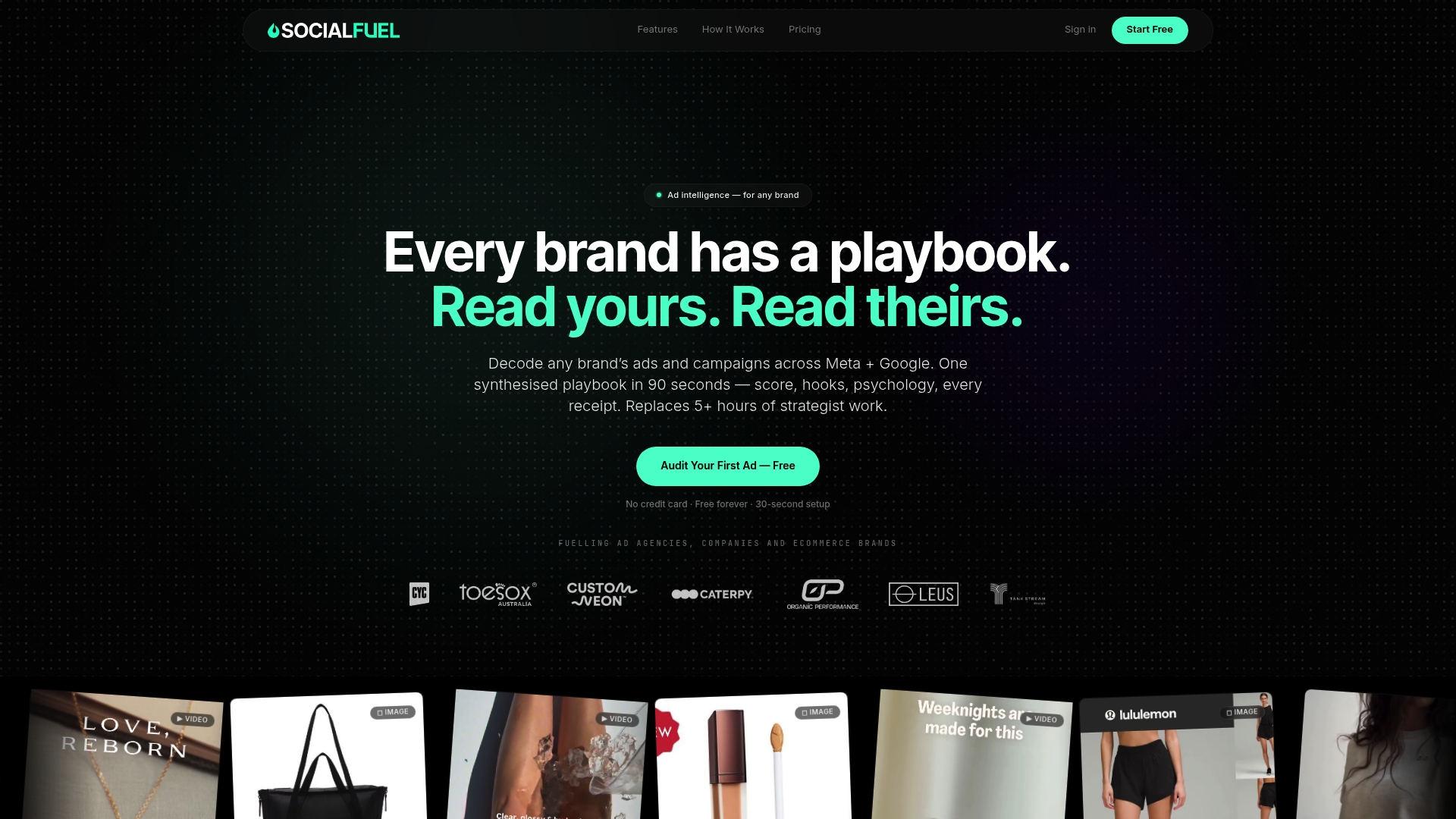
For creators building their Kickstarter marketing strategy, that means less guessing and faster iteration. Search your niche on Socialfuel to see which ad angles are converting right now, build your swipe file, and brief your creative team with real data instead of assumptions. Smarter creative starts with knowing what already works.
FAQ
When should I start running ads for my Kickstarter campaign?
Start pre-launch ads 8–12 weeks before your launch date to build your email list and warm your audience. Earlier starts lower your cost per lead and give you time to test creatives before peak spend.
Do Kickstarter ads work for small budgets?
Paid ads work at small budgets if you allocate spend carefully. Start with at least $20 per day per ad set to exit the algorithm’s learning phase, and focus early spend on email capture rather than direct pledges.
What type of ad creative performs best for crowdfunding?
Campaign videos raise three times more funds than static images and should be your primary creative format. Short-form video hooks in the first three seconds work best for cold audiences.
Should I send ad traffic directly to my Kickstarter page?
No. Send cold traffic to a landing page first to capture emails and build a retargeting pool. Direct cold traffic to Kickstarter wastes budget on audiences that are not ready to pledge.
What is the most important metric for Kickstarter ads?
Cost per Purchase is the key metric, not click-through rate. High clicks without conversions signal a mismatch between your ad and your campaign page that no amount of additional spend will fix.