Search for how often you should refresh Facebook ad creative and you get a number. Every one to two weeks on high-spend campaigns. Every two to four weeks on broader audiences. Every 14 to 28 days at scale.
Those numbers describe a drip: a steady trickle of new ads, one or two at a time, forever. So we went and looked at what advertisers actually do, using ads anyone can pull up in the Meta Ad Library.
They do not drip. They launch in batches, and the gaps in between are longer than the advice suggests.
What we measured
We took every creative our platform had captured as live from 18 advertiser Pages, deduplicated by advertiser and ad body (taking the earliest start date for each duplicate), and grouped what was left by the day it started running.
That left 773 live creatives across 340 launch days, measured as of 24 August 2026. The set spans global consumer brands including Dior, Gymshark, HelloFresh, Red Bull, Liquid Death, Adobe, Oakley and True Protein, through to small single-market advertisers running fewer than a dozen ads.
The deduplication matters more than it sounds. Duplicating an ad rather than editing it creates a brand new ad record with a fresh start date, and buyers duplicate on purpose to reset the learning phase. Without collapsing identical copy, the same creative shows up repeatedly and every cadence number inflates.
Most live ads arrived with siblings
Of the 773 live creatives, 574 (74.3%) started on the same day as at least one other ad from the same advertiser. Across the whole set that works out to 2.27 ads per launch day.
This is a floor, not a ceiling. Our capture of any given advertiser is partial, and a partial capture can only ever break clusters apart. If an ad's only same-day sibling is missing from our data, that ad looks like a solo launch. Missing ads can turn a batch into singles. They can never turn singles into a batch. The true clustering is higher than 74.3%.
The paradox in the chart
Here is where the drip model actually breaks. Count launch days and you get one story. Count ads and you get the opposite one.
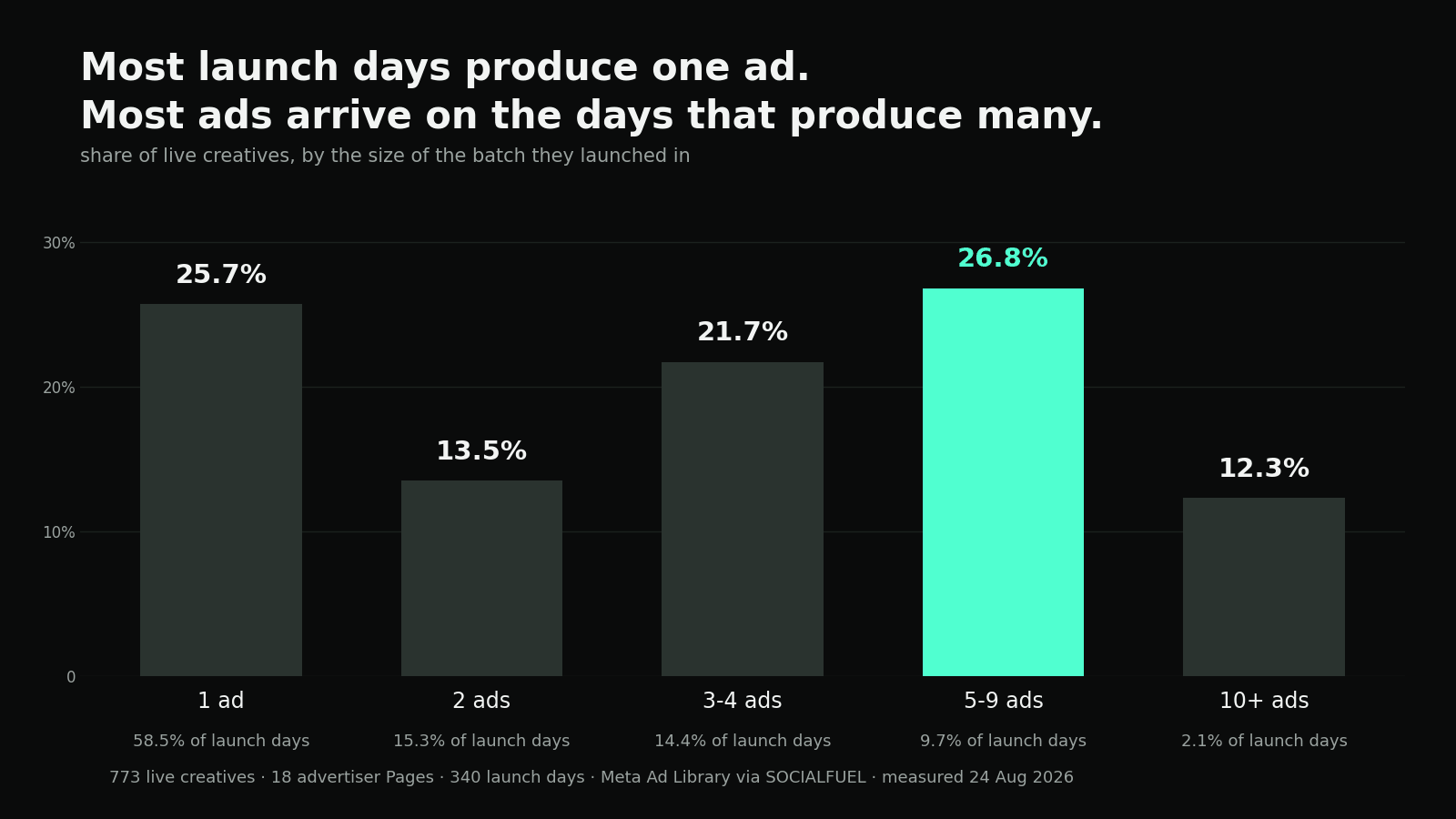
- 58.5% of launch days produced exactly one ad, but those days account for only 25.7% of the live creatives.
- 2.1% of launch days produced ten or more ads, and those seven days alone account for 12.3% of everything running.
- Widen that to cohorts of five or more: 11.8% of launch days produced 39.1% of the live library.
So an advertiser's day-to-day looks like a drip, because most days that produce anything produce one thing. But the library people actually see is dominated by a handful of big days. The median advertiser in our set had 35 live creatives that arrived across just 17.5 launch days, and went a median of 3.75 days between launches while starting new ads on only 12.8% of the days in its own window.
Gymshark: one week built the library
The clearest case in the set. Gymshark had 36 live creatives spread over 11 launch days, and the distribution is nothing like a schedule:
- 21 of the 36 started on a single day, 2 July 2026, which is 58.3% of everything they had running.
- 30 of the 36 (83.3%) started inside one eight-day window, 30 June to 7 July.
- Only two surviving creatives predate that window, from early and mid March. Between 18 March and 30 June, nothing Gymshark launched was still running at measurement.
Read carefully, that last point is about survivors, not about activity. We can only see ads that were still live when we measured, so a quiet stretch means no ad from that period survived, not necessarily that nothing was launched. That distinction is the honest version of the claim and we are not going to blur it.
These are campaign launches, not fatigue swaps
The format mix gives away what is really happening. Across the 89 launch-day cohorts containing three or more ads, 56 of them (62.9%) mixed at least two different ad formats on the same day. Gymshark's 2 July cohort ran video, image and carousel together.
A fatigue-driven refresh replaces a tired creative with a fresh version of the same thing. You do not ship 21 assets across three formats because click-through rate slipped last Tuesday. You ship that because a campaign, a drop or a season went live, and the creative was produced as a set well before anything fatigued.
Which means the fatigue-cadence advice and the observed behaviour are answering two different questions. Fatigue governs when you retire an ad. Production governs when new ads appear. The second one is what you actually see in an ad library, and it runs on the calendar, not on the metrics.
What this changes
Stop reading ad count as effort. A competitor with 36 live ads did not make 36 decisions. Gymshark made roughly 11, and one of them produced most of the library. When you benchmark against a competitor's volume, you are benchmarking against their production schedule, not their testing discipline.
Count launch days, not ads. It is the far better cadence signal, and it is free to derive. Sort any advertiser's live ads by start date and look at how many distinct days appear. Twelve ads across twelve days is a genuine testing programme. Twelve ads across two days is one campaign that happens to have twelve assets.
Plan production in batches, review in weeks. The brands in this set behave as though creative comes in sets and gets reviewed continuously, which is close to the opposite of producing one new ad every fortnight. Batching also matches how creative actually gets made, since a shoot or a design sprint yields a set, not a single asset.
Treat a sudden cluster as news. If a competitor's library jumps by ten ads in a day across mixed formats, that is a launch worth understanding, and it is visible the day it happens. A trickle of one ad here and there usually is not.
What this data cannot tell you
Three limits, stated plainly, because a study that only lists its findings is selling something.
We see survivors, not launches. Every ad here was live at measurement. Ads that launched and were switched off before 24 August are invisible to us, so the quiet periods are quieter than reality and the clustering we report is a floor.
Our capture of each advertiser is partial. These counts describe what we hold, not a census of everything each brand runs. That is why we report shares and shapes rather than claiming a total for any single brand.
We cannot see spend or impressions, and neither can anyone else. Across all 2,661 records in this dataset, zero carried a spend figure and zero carried an impression count. Meta publishes those ranges for political and social-issue advertising only. Every tool showing you a commercial competitor's Meta spend is modelling it, and the model is not the measurement.
Frequently asked questions
How often do brands actually launch new Facebook ads?
In this set, the median advertiser started new ads on 12.8% of the days in its window, with a median gap of 3.75 days between launch days, and its live library arrived across a median of 17.5 distinct days. Launches cluster: 74.3% of live creatives started on the same day as at least one sibling.
How often should I refresh my Facebook ad creative?
The honest answer is that refresh timing and launch timing are different decisions. Retire an ad on its own performance signals. Produce new creative in batches on a schedule you can actually sustain, because that is what the brands in this data appear to do.
Does a competitor with more live ads have a bigger budget?
You cannot conclude that. Ad count reflects how many assets a campaign shipped, and one launch day can produce twenty. Meta withholds commercial spend entirely, so anyone quoting a competitor's Facebook ad spend is showing you an estimate.
How can I tell if a competitor just launched a campaign?
Look for several ads sharing one start date, especially across mixed formats. In our data, 62.9% of cohorts of three or more ads combined at least two formats on the same day, which is the signature of a planned launch rather than a fatigue swap.
Why do so many competitor ads show the same start date?
Two reasons. Campaigns ship as sets. And duplicating an ad instead of editing it creates a new record with a fresh start date, which buyers do deliberately to reset the learning phase. That is why we deduplicate by ad body before counting anything.
See this for your own market
Every number here came from ads anyone can look up. The work was in collecting them, deduplicating them and grouping them by the day they started.
That is what SOCIALFUEL does: search any brand, see their live ads across Meta, Instagram, Google and TikTok, sorted so the long-runners surface first, then decode why each one works. It is free to start, with no credit card and no ad-account connection.
Related reading: how long Facebook ads actually run covers the other half of this question, and how many Facebook ads to run at once deals with concurrency. If you are comparing tools, start with best ad spy tools.
We will re-run this study next quarter. The number worth watching is whether that 74.3% moves.
About the author
Joel Helou is the founder of SOCIALFUEL, a growth agency that manages paid social and search campaigns for ecommerce and DTC brands, and the creator of socialfuel.io. He has spent the past decade buying media for brands across apparel, supplements and consumer goods, and now builds the tooling his own team uses to decode why competitors' ads work. This study was run on data captured through that platform.