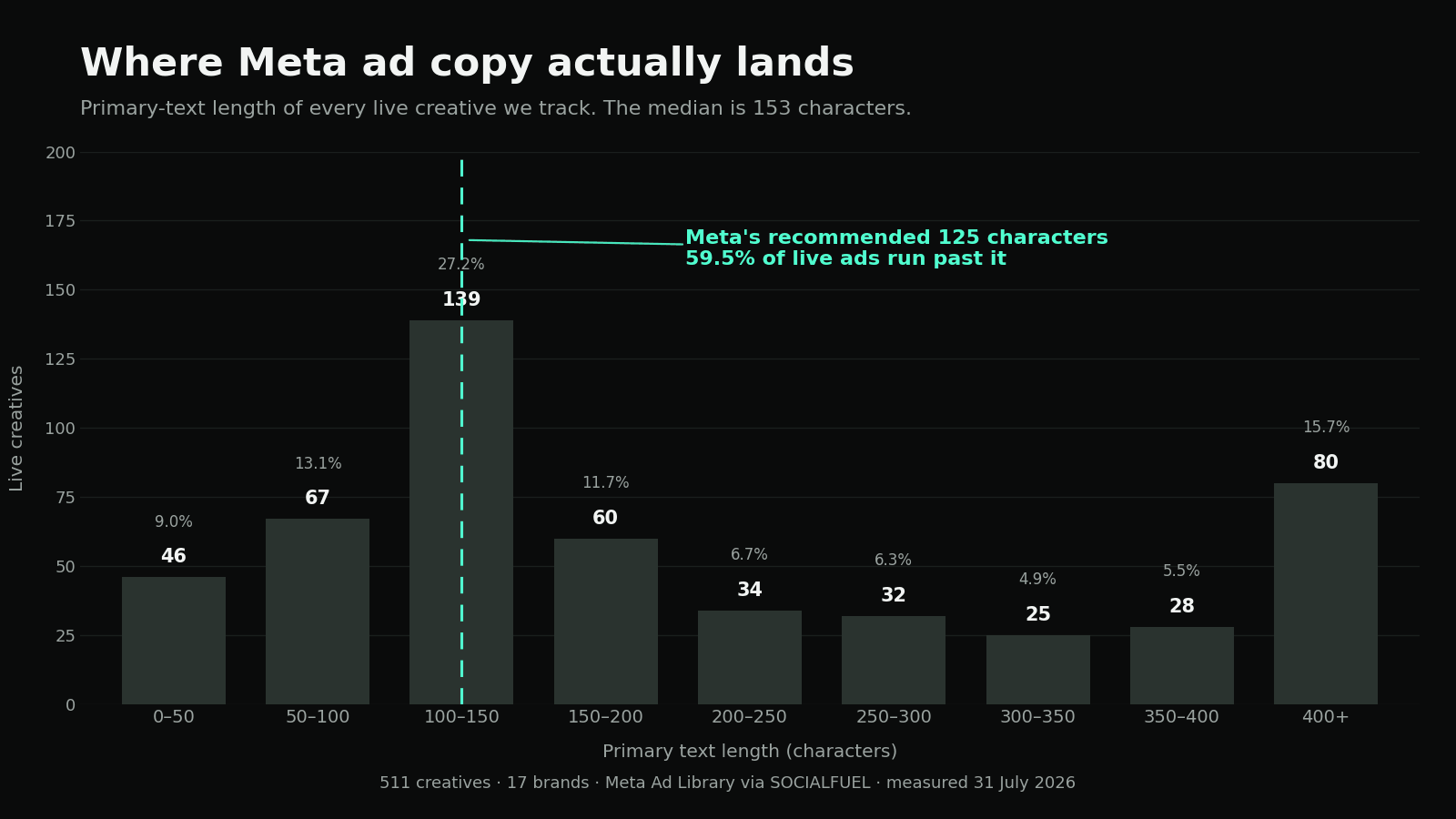
Ask how long Facebook ad copy should be and you get the same answer everywhere: keep it under 125 characters, because that is where Meta truncates the primary text and adds "See more". Nobody seems to have checked whether working advertisers actually do it. So we did.
On 31 July 2026 we measured the primary text of every live creative we track through the public Meta Ad Library: 511 unique live ads across 17 brands, including Red Bull, Gymshark, Dior, Adobe, HelloFresh, Oakley, ROLEX, Liquid Death and True Protein.
The median live ad is 153 characters. 59.5% of them run past the 125-character recommendation. And length turns out to have almost no relationship with how long an ad survives.
How long is Facebook ad copy in practice?
Here is the full distribution of primary-text length across those 511 creatives.
| Primary text | Live creatives | Share |
|---|---|---|
| 0–50 characters | 46 | 9.0% |
| 50–100 | 67 | 13.1% |
| 100–150 | 139 | 27.2% |
| 150–200 | 60 | 11.7% |
| 200–250 | 34 | 6.7% |
| 250–300 | 32 | 6.3% |
| 300–350 | 25 | 4.9% |
| 350–400 | 28 | 5.5% |
| 400+ | 80 | 15.7% |
The summary statistics: median 153 characters (about 25 words), mean 219, lower quartile 106, upper quartile 310. The 90th percentile sits at 456 characters and the longest live ad in the set runs to 1,248.
Two shapes stand out. There is a real cluster around the recommended length — the 100–150 bucket is the single largest at 27.2%. But there is also a substantial long-copy tail: 15.7% of live ads exceed 400 characters, more than triple the recommendation. Only 7.4% are genuinely short, at 40 characters or fewer.
The 125-character rule, tested
Of 511 live creatives, 207 (40.5%) are at or under 125 characters. The other 304 (59.5%) are not.
So the most-repeated rule in Facebook ad copywriting describes a minority of what is actually running. That does not make it wrong — Meta's guidance is about what displays without truncation, which is a real constraint. But it is taught as a length limit when it is really a visibility threshold, and six in ten live ads treat it as the latter.
Does shorter copy last longer?
This is the question that matters. We cannot see anyone's results — Meta withholds spend and impressions for commercial advertisers — but we can see how long an advertiser keeps paying for a creative. An ad still live after months has survived a budget-holder's scrutiny, which is the closest thing to validated performance observable from outside an ad account. If short copy really did win, short ads should dominate the long-runners. They do not.
| Copy length | Live ads | Median days live | Still running past 90 days |
|---|---|---|---|
| Under 125 characters | 207 | 31 | 10.6% (22) |
| 125–250 | 139 | 33 | 6.5% (9) |
| 250–500 | 131 | 32 | 3.8% (5) |
| Over 500 | 34 | 39 | 5.9% (2) |
Median longevity is effectively flat across every length band: 31, 33, 32 and 39 days. Whatever decides that an ad keeps running, copy length is not it.
The past-90-day column drifts downward, and short copy holds the highest rate at 10.6%. We are not going to build an argument on it: those percentages rest on 22, 9, 5 and 2 ads, and the over-500 band reverses the trend. Treat the flat medians as the finding and that column as noise until a bigger sample says otherwise.
What long-copy ads actually do differently
Here is the part that resolves the argument.
We looked at the 304 live ads that exceed 125 characters and asked where their first line break falls. 204 of them — 67% — place a line break inside the first 125 characters.
Long-copy advertisers are not ignoring the truncation point. They are writing to it. The opening line is built to stand alone above the "See more" fold, and everything beneath it is a second act for readers who expand. Across the whole set only 53.4% of ads contain a line break at all, so this is not an artefact of how people type — it is far more common in the ads that need it.
The real rule is not "stay under 125 characters". It is "make the first 125 characters work on their own". That is a formatting instruction, not a word budget, and it is what two thirds of long-copy advertisers already do.
Copy length is a brand decision, not an industry rule
Averages hide the most useful finding. Split by advertiser and the spread is enormous.
| Brand | Live ads | Median characters | Under 125 |
|---|---|---|---|
| Red Bull | 24 | 28 | 92% |
| Gymshark | 33 | 64 | 97% |
| Oakley | 18 | 104 | 89% |
| HelloFresh | 24 | 114 | 88% |
| Liquid Death | 25 | 119 | 60% |
| Dior | 53 | 147 | 34% |
| Adobe | 32 | 179 | 34% |
| True Protein | 56 | 374 | 4% |
| ROLEX | 12 | 395 | 8% |
Red Bull's median ad is 28 characters. ROLEX's is 395. That is a 14× spread between two brands both running sustained Meta campaigns in the same month.
The split is not random, and it is not about budget. Red Bull, Gymshark and Oakley are selling recognisable products to people who already know the category — the image carries the message and the copy is a caption. True Protein and ROLEX are selling specification and justification, so the copy has work to do that a picture cannot.
Gymshark's discipline is the sharpest in the set: 97% of its live ads sit under 125 characters. One of them, at 50 characters, has been running for 111 days:
Plus get 10% off your first order with code APP10.
That is the whole of the primary text.
Adobe runs both, at the same time
The clearest evidence that there is no universal answer comes from inside a single advertiser.
Adobe's longest-running live creatives are three ads launched on 12 February 2026, still running at 169 days, at 88, 103 and 122 characters. Short, product-led, well inside the recommendation.
Adobe is also running a 707-character video ad that launched on 19 March and has been live 134 days. It opens like this:
Meet Amanda Valenzuela, Business Development Representative at Adobe and a multi-disciplinary artist 🎨☕️
Then it breaks, and keeps going for another 600 characters about her path from barista at the San Jose office to working with marketing leaders.
Same advertiser, same quarter, a 5.8× difference in copy length, both sustained for over four months. The 707-character ad follows the pattern above precisely: a self-contained opening line, then the break, then the substance. Length was never the variable. The job of the ad was.
What to do with this
Stop treating 125 as a limit. Treat it as the space your ad has to earn the expand. Six in ten live ads already do.
Put a deliberate line break in. If your copy runs past 125 characters, write the opening so it works alone and break there on purpose. Two thirds of long-copy advertisers do this and it costs nothing to adopt.
Match length to the job, not to a benchmark. Known product plus warm audience behaves like Gymshark at 64 characters. Considered purchase or an unfamiliar claim behaves like True Protein at 374. Copying the wrong brand's length is worse than ignoring the rule.
Do not expect length to save a weak ad. The medians are flat at every band. The hook, the offer and the audience decide whether an ad survives — which is what our study of how long Facebook ads actually run found: only 11% of live creatives make it past 90 days.
Method, and what this cannot tell you
Every ad here is public. We pulled live creatives from 17 tracked brands through the Meta Ad Library, deduplicated by advertiser page and body text so repeated placements of one creative count once, kept only ads marked active with non-empty primary text, and measured character length and days since launch against a pinned date of 31 July 2026. Ad-intelligence tools were excluded from the sample so the set reflects brands advertising products.
The limits are real and worth stating plainly:
- This is not performance data. Meta publishes spend and impressions only for political and social-issue advertising. For commercial brands both fields are empty on effectively every record we hold. Any tool showing you a competitor's Meta spend is modelling it, not reporting it.
- Longevity is a proxy. It means an advertiser chose to keep funding an ad, which is meaningful but is not the same as profitability.
- 17 brands is a sample, not the market. It skews consumer and DTC. A B2B or local-services set would likely land differently.
- The numbers drift daily. Every figure was re-derived on 31 July 2026; a reading a fortnight from now will differ.
Frequently asked questions
How long should Facebook ad copy be?
There is no single right length. Across 511 live ads from 17 brands measured on 31 July 2026, the median is 153 characters and per-brand medians range from 28 to 395. Match length to how much explaining your offer needs, and make the first 125 characters work on their own.
What is the character limit for Facebook ad primary text?
Meta recommends 125 characters for primary text because that is roughly where it truncates with a "See more" link across placements. The field accepts far more, and in our sample 59.5% of live ads exceed it, with the longest running to 1,248 characters.
Do short Facebook ads perform better than long ones?
We cannot measure performance, but we can measure survival. Median time live was 31 days for ads under 125 characters, 33 for 125–250, 32 for 250–500 and 39 for over 500. Length did not separate the long-runners.
What is the average length of a Facebook ad?
In our sample the mean is 219 characters and the median is 153, or about 25 words. The median is the more useful figure because a long-copy tail pulls the mean upward.
Should I put line breaks in Facebook ad copy?
The data says yes if your copy is long. Of the 304 live ads exceeding 125 characters, 204 (67%) place a line break inside the first 125, so the opening reads as a complete thought before the "See more" cut.
Can you see how much a competitor spends on Facebook ads?
No. Meta discloses spend and impression ranges only for political and social-issue advertising. For commercial advertisers those fields are empty. What you can see is what they are running, how it is written and how long it has survived.
See this for your own market
Every number here came from ads anyone can look up. The work was in collecting them, deduplicating them and measuring them consistently.
That is what SOCIALFUEL does: search any brand, see their live ads across Meta, Instagram, Google and TikTok, sorted so the long-runners surface first, then decode the hook, angle, offer and audience behind each one. Free to start, no credit card, no ad-account connection.
If you are comparing tools, we have written up how the options stack up in best ad spy tools, with direct comparisons for Foreplay and Adspo.
We will re-run this each quarter. The question worth watching is whether that 59.5% keeps climbing.
About the author
Joel Helou is the founder of SOCIALFUEL, a growth agency that manages paid social and search campaigns for ecommerce and DTC brands, and the creator of socialfuel.io. He has spent the past decade buying media for brands across apparel, supplements and consumer goods, and now builds the tooling his own team uses to decode why competitors' ads work. This study was run on data captured through that platform.