Open any brand in the Meta Ad Library and you can see every ad they are running right now. What you cannot see is which ones are making money. Meta withholds spend and results for commercial advertisers, so the whole industry leans on one proxy: if an ad has been running a long time, it must be working.
That proxy is real. It is also applied with numbers nobody has ever checked. So we checked them.
On 3 August 2026 we pulled the complete live US ad population for 13 brands from Meta's public Ad Library. Not a sample of each account, every active ad: 1,622 creatives. Then we looked at when each one started running.
Those 1,622 ads started on 187 days between them. Ninety-six per cent of them launched on the same day as at least one sibling ad.
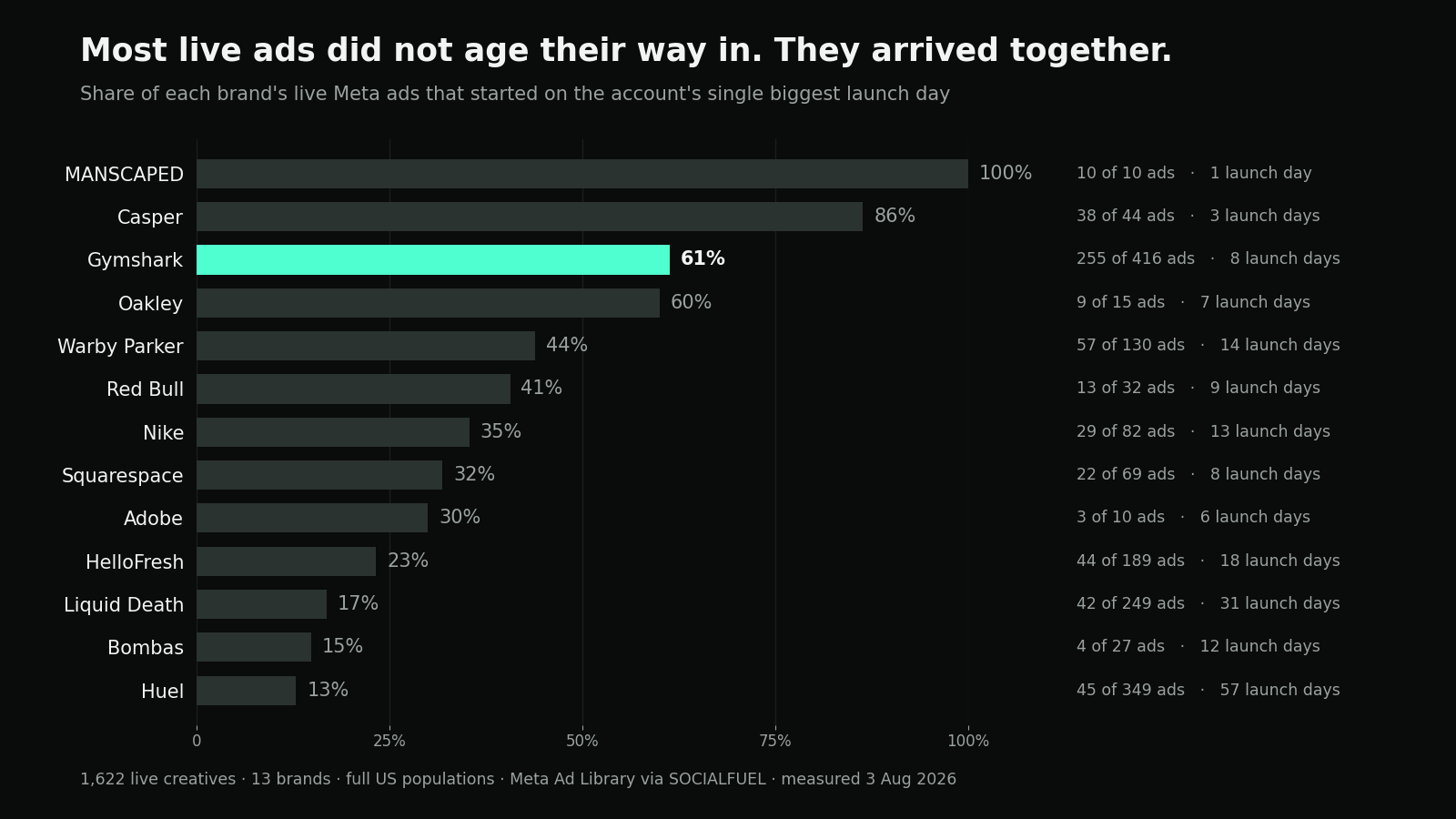
1,622 live creatives · 13 brands · full US populations · Meta Ad Library via SOCIALFUEL · measured 3 Aug 2026
The short answer
You cannot tell whether a competitor's ad is profitable. Nobody can, from the outside. What you can do is read three signals in order:
1. How long the ad has been running, compared with the rest of that brand's account rather than against a fixed number of days. 2. How many siblings launched with it. An ad that went live alone, or in a small group, and is still up months later has survived something. One of 255 ads pushed out on a single day has not survived anything yet. 3. What the brand keeps repeating. Angles a brand rebuilds again and again are the ones earning their slot.
Here is the evidence for why the popular version of rule one is wrong.
The rule everyone repeats
Search this question and the answer is unanimous. An ad live for 45 days is "almost certainly profitable". Anything past 30, 60 or 90 days is a winner. Nobody funds a loser for six weeks.
The logic is sound. The thresholds are guesses, and they assume something untrue: that ads age one at a time, so an account is a slow race where the good ones pull ahead.
Ads do not trickle out. They arrive in batches
That is the finding, and it is not subtle.
Gymshark had 416 live ads we could retrieve. They started on eight days. Two hundred and fifty-five of them, 61% of the account, went live on 2 July. Not one ad in the account was older than 31 days.
Read that through the popular rule and you would conclude Gymshark has no winning ads at all. Obviously false. What you are actually seeing is a brand that rebuilds creative in large batches, and start dates that reset when it does.
The pattern repeats at every size:
- MANSCAPED: 10 live ads, one launch day. All ten started 31 July.
- Casper: 44 live ads, three launch days. Thirty-eight of them launched on 30 July.
- Warby Parker: 130 live ads, 14 launch days, 57 of them on 1 July.
- Huel, the most staggered account in the set, still put 349 ads across just 57 days.
There is a mechanical reason. When an advertiser duplicates an ad rather than editing it, Meta treats the copy as a brand new ad with a brand new start date, and media buyers duplicate deliberately to reset the learning phase on a fatiguing ad. So "days running" measures the age of the current ad record, not the age of the idea. A creative that has earned its place for a year can show up as two days old.
The first page of the Ad Library will lie to you
There is a second trap, and we walked into it ourselves before catching it.
The Ad Library ranks results by impressions. The highest-spending ads surface first, and high spend correlates with age, so the first page is the oldest slice of the account presented as if it were a sample of it.
The same brand, same day, measured two ways:
| HelloFresh, 3 Aug 2026 | Median age | Still running past 90 days |
|---|---|---|
| First 30 ads as they appear | 41 days | 27% |
| All 189 live ads | 10 days | 6% |
The first page overstates the median age by four times and the 90 day survival rate by four and a half. The same gap shows at Huel, where the first 30 ads suggest 63% are past 90 days and the full 349 say 32%.
If you eyeball a competitor's ad library for two minutes and form an impression, that impression is the survivor slice. Page to the end before you conclude anything.
"Long-running" means something different at every brand
Once you have full populations, the absolute thresholds fall apart. Across these 13 accounts:
| Brand | Live ads | Median age | Past 30 days | Past 90 days | Oldest ad |
|---|---|---|---|---|---|
| Gymshark | 416 | 31d | 61% | 0% | 31d |
| Huel | 349 | 52d | 65% | 32% | 229d |
| Liquid Death | 249 | 48d | 88% | 24% | 95d |
| HelloFresh | 189 | 10d | 19% | 6% | 95d |
| Warby Parker | 130 | 23d | 47% | 0% | 32d |
| Nike | 82 | 18d | 2% | 2% | 138d |
| Squarespace | 69 | 26d | 35% | 35% | 161d |
| Casper | 44 | 3d | 14% | 0% | 72d |
| Red Bull | 32 | 33d | 59% | 0% | 34d |
| Bombas | 27 | 17d | 15% | 15% | 136d |
| Oakley | 15 | 13d | 20% | 13% | 417d |
| Adobe | 10 | 2d | 40% | 0% | 62d |
| MANSCAPED | 10 | 2d | 0% | 0% | 2d |
Pooled across all 1,622 ads the median is 31 days and 13% are past 90. But the typical brand looks nothing like the pool: the median brand has 35% of its ads past 30 days and 2% past 90.
A 60 day old ad is unremarkable at Huel, where a third of the account is older. The same 60 day old ad at Casper would be the second oldest thing they are running. The threshold has to come from the account, not from a blog post.
What actually signals a winner
Sort the brand's full live population by age, then look for ads that are old and alone.
Casper is the clean example. Forty-four live ads, and 38 of them launched three days before we measured. Underneath that wave sit five ads that have been running since 22 May, and one since 24 June. Those five are the entire signal in the account. They survived a full creative refresh that replaced everything around them.
Oakley runs 15 ads. Nine went live on the same day in July. One has been running since 11 June 2025, 417 days. That ad is not a survivor of a batch, it is a fixture.
Squarespace is the interesting counter-case: their biggest cohort, 22 ads, launched on 22 February and is still live at 161 days. A whole batch that stuck. That is a different and stronger signal than a lone survivor, and you only see it by grouping on start date.
So the working method is:
1. Pull the brand's whole live set, not the first page. 2. Group by start date to find the launch cohorts. 3. Ignore the newest cohort entirely. It has proven nothing. 4. Look at what sits above it: the ads and cohorts that outlived a refresh. 5. Read those for the hook, the angle and the offer, then test that structure against your own audience.
What this cannot tell you
Being straight about the limits is the point, because plenty of tools are not.
Meta does not publish spend or impressions for commercial advertisers, so any figure quoted as a brand's "estimated ad spend" is a model, not a measurement. We do not publish those numbers because we cannot observe them.
Longevity is a proxy and only a proxy. A long-running ad is very likely earning its budget, but it might also be a brand-awareness placement on a different objective, or one someone forgot to switch off. And as shown above, a short-running ad may be a year-old winner that was duplicated last week.
One disclosure: we retrieved 416 of Gymshark's 431 reported active ads, 96.5% of that account. Everything else in the table is the complete population Meta reported that day. All figures were measured on 3 August 2026 and will have drifted since, which is exactly why re-deriving them beats remembering them.
FAQ
Can you see how much a competitor spends on Facebook ads? No. Meta publishes spend ranges only for ads about social issues, elections or politics. For commercial advertisers, spend and impressions are withheld. Any tool showing you an estimated spend figure for a retail brand is modelling it.
Does an ad running for 90 days mean it is profitable? It is a reasonable bet, but it is rarer than the advice implies. Across the 13 brands we measured, the median brand had 2% of its live ads past 90 days, and six of the 13 had none at all. Judge an ad against its own account's distribution instead.
Why do all of a brand's ads have the same start date? Because they were launched, or relaunched, together. Duplicating an ad creates a new ad record with a fresh start date, and buyers do this on purpose to reset delivery on a fatiguing creative. Gymshark's 416 live ads shared just eight start dates on the day we measured.
How do I see all of a competitor's ads instead of just the first page? The Ad Library ranks by impressions, so you have to scroll to the end of the account rather than reading the top. That is the part worth automating, because the first page systematically overstates how long the average ad has been running.
See this for your own market
Every number here came from ads anyone can look up. The work was in pulling complete populations rather than first pages, and grouping them by launch date.
That is what SOCIALFUEL does: search any brand, see their live ads across Meta, Instagram, Google and TikTok, sorted so the long-runners surface first, then decode why each one works. It is free to start, with no credit card and no ad-account connection.
We measured the same shape from a different angle in how long Facebook ads actually run, and read a single account end to end in how HelloFresh advertises. If you are choosing between tools, there are direct comparisons for Foreplay and Adspo.
About the author
Joel Helou is the founder of SOCIALFUEL, a growth agency that manages paid social and search campaigns for ecommerce and DTC brands, and the creator of socialfuel.io. He has spent the past decade buying media for brands across apparel, supplements and consumer goods, and now builds the tooling his own team uses to decode why competitors' ads work. This study was run on data captured through that platform.