You searched a competitor in the Meta Ad Library, got "No ads match your search" and assumed they had stopped advertising. Almost always, they have not. In our experience the overwhelming majority of empty Ad Library searches are one of eight fixable problems, and the first two account for most of them.
Here is the whole answer up front.
| Why you see nothing | The fix |
|---|---|
| Country filter is set to where you are, not where they advertise | Change the country selector, or set it to a market they actually sell in |
| You typed a website address instead of a Facebook Page name | Meta searches Page names, not domains. Search the Page name |
| The ad category is still on "Issues, elections or politics" | Switch it to "All ads" |
| You picked the wrong Page from the dropdown | Regional and product Pages look identical. Go via Page Transparency instead |
| The ads run from a Page that is not the brand's | Creator, agency and partnership ads sit under the creator's Page |
| The ad stopped, so it is gone | Non-political ads are only in the library while they are live |
| They advertise, but not on Meta | Check Google's Ads Transparency Center and TikTok separately |
| You checked one country and they run in twelve | Country is a filter, not a setting. Repeat it per market |
The rest of this article is the detail on each one, then the shortcut that skips the whole exercise.
1. Your country filter is wrong (start here)
This is the single most common cause and it is invisible, because the Ad Library never tells you it has filtered you out.
The library shows ads delivered to a country you choose, not ads run by a company based there. If the selector is sitting on your own location and your competitor's media budget is pointed somewhere else, the correct and unhelpful answer is zero ads.
This is not a quirk of the web interface. In Meta's own Ad Library API, ad_reached_countries is a required parameter. There is no such thing as a global query. Every search you run is already a country search, whether you chose the country or not.
The fix: change the country selector before you conclude anything. If you do not know where they advertise, try their home market first, then the market their website prices in.
2. You searched a website, not a Page name
People paste brand.com into the Ad Library and get nothing. The Meta Ad Library search box matches advertiser Page names and ad text. It is not a domain lookup.
Worth knowing because the platforms differ here: Google's Ads Transparency Center explicitly does let you "search for an advertiser via the Ads Transparency Center using the advertiser or website name". Meta does not. If your mental model came from Google, this is where it breaks.
3. The ad category is still set to politics
The Ad Library makes you choose a category. If it is left on "Issues, elections or politics", a commercial brand returns nothing, forever, no matter how many ads they are running.
This is a real division in the data rather than a UI preference. Meta's API exposes ad types as ALL, POLITICAL_AND_ISSUE_ADS, HOUSING_ADS, EMPLOYMENT_ADS and FINANCIAL_PRODUCTS_AND_SERVICES_ADS. Those last three are regulated categories with their own disclosure rules. A DTC skincare brand lives in none of them.
Set the category to "All ads" and search again.
4. You found the wrong Page
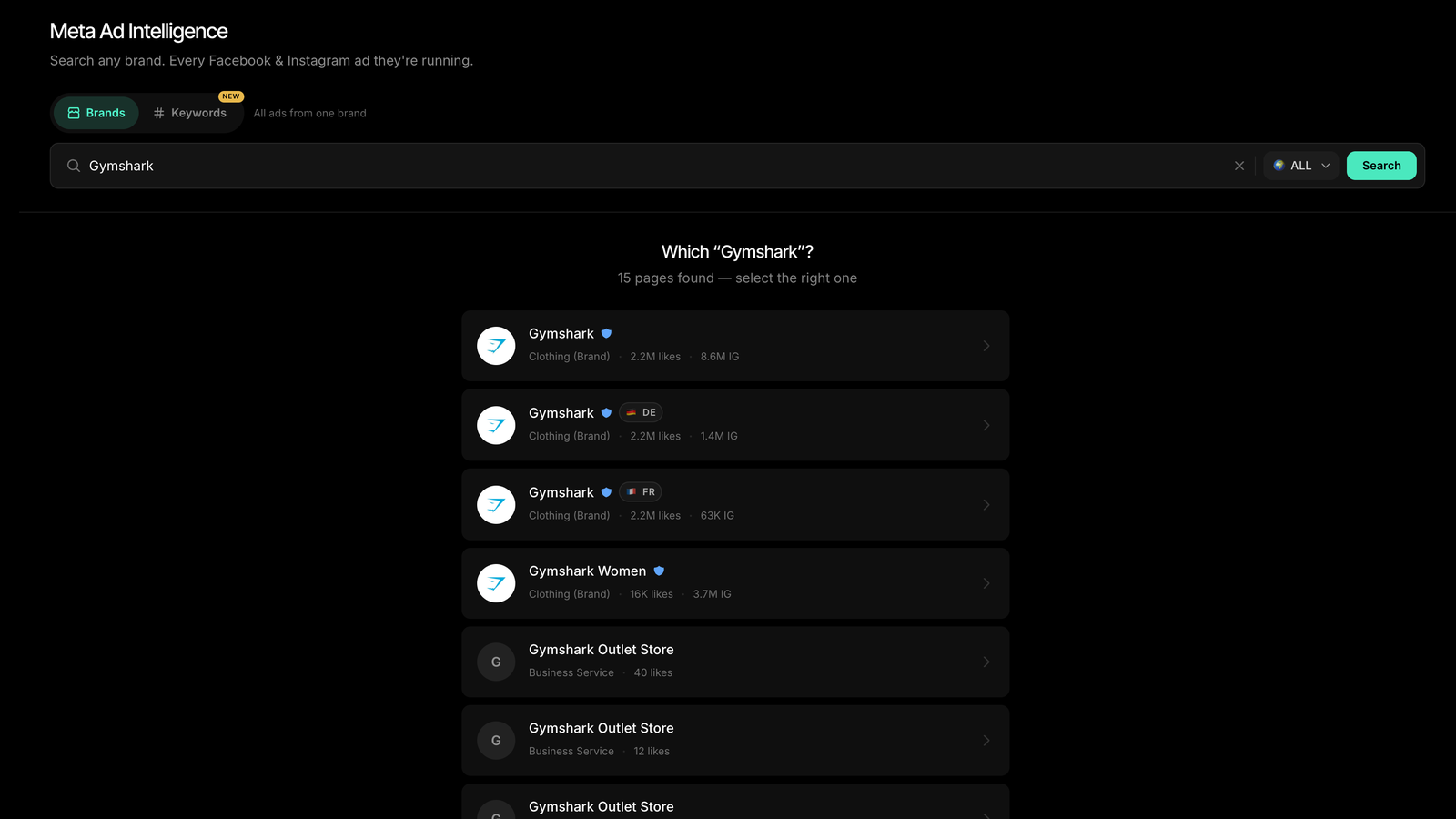
Large brands run several Facebook Pages: a global Page, regional Pages, product Pages, an old Page nobody archived, and frequently an impersonator or two. They all look plausible in a dropdown, and only one of them is buying media this quarter.
The reliable route avoids the search box entirely:
- Open the brand's Facebook Page.
- Scroll to Page transparency and expand it.
- Follow the link through to the Ad Library.
That resolves the exact Page ID, so spelling, duplicates and impersonators stop mattering. If the section says the Page is not currently running ads, that is a genuine answer rather than a search failure — which is the whole point of using it.
5. Their ads are running under somebody else's Page
This one quietly defeats most competitor research, and almost nobody accounts for it.
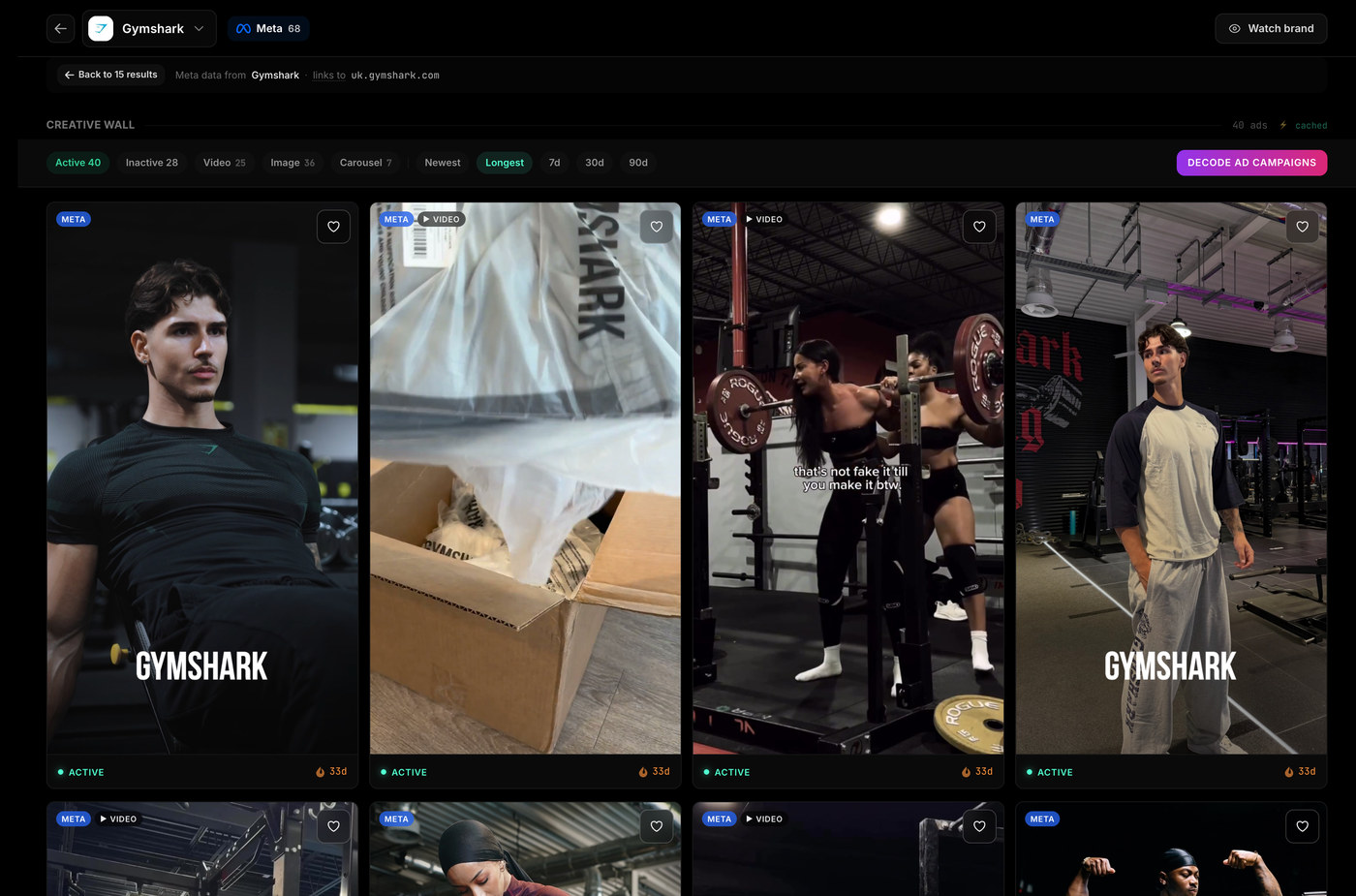
A great deal of paid social does not run from the brand's own Page. Creator and partnership ads are delivered through the creator's account with the brand as the paying advertiser. Agencies sometimes run from their own assets. Sub-brands run from sub-brand Pages.
So a brand can be spending heavily while their own Page shows a handful of ads. If a competitor's ad volume looks implausibly low next to how often you see them in the wild, this is usually why. Search the ad copy itself — a distinctive phrase, a discount code, a product name — rather than the Page, and the ads surface under whichever Page is actually running them.
6. The ad stopped, so it no longer exists
You saw a competitor's ad last month, went to look it up, and it is gone. That is expected behaviour, not a bug.
Meta's own description of the library is that "people can search for all active ads running across products from Meta". Emphasis on active. For ads about social issues, elections or politics, the rules are different: those "are visible whether they're active or inactive and are stored in the Ad Library for 7 years". Commercial ads get no such archive.
There is one partial exception. Meta states that ads delivering an impression in the EU "are displayed in the Ad Library while active and archived for one year upon the delivery of their last impression". So an EU-delivered ad has a year of afterlife; a US-only commercial ad has none.
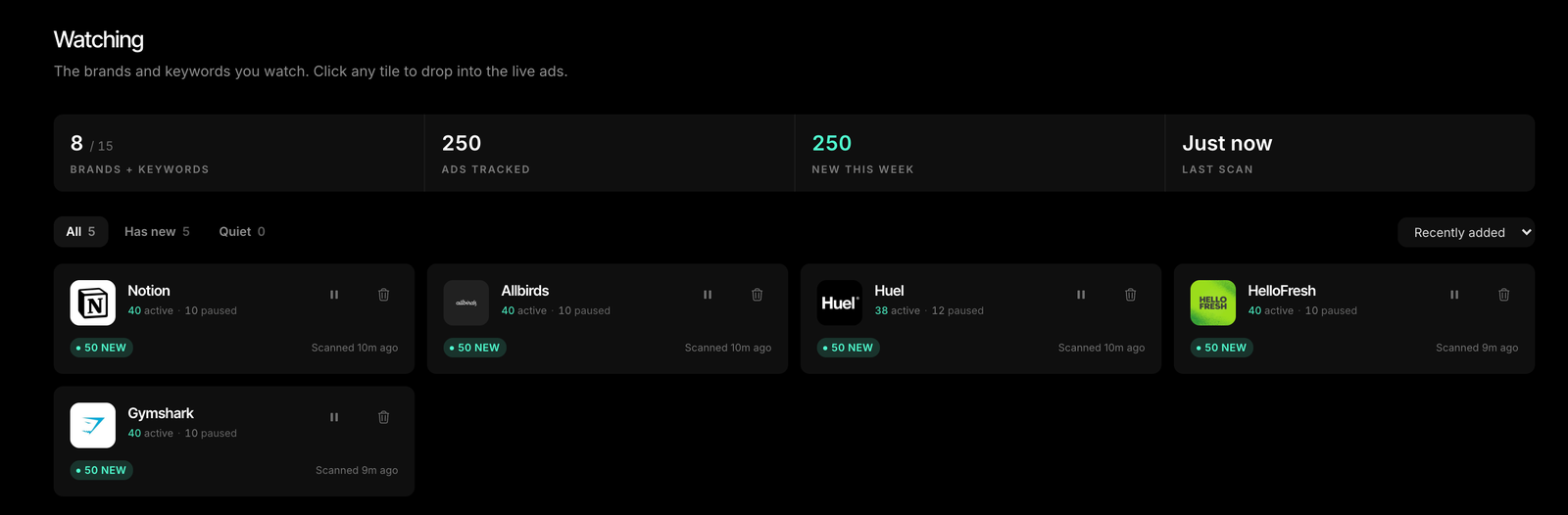
The practical consequence is that competitor ad research is not a thing you do once. If you did not capture it while it ran, it is not recoverable. This is the entire argument for tracking a brand continuously instead of checking on them quarterly.
7. They advertise, just not on Meta
An empty Meta result is evidence about Meta and nothing else. Plenty of businesses — B2B, considered-purchase, local services — put most of their budget into Google search, where intent is already formed.
Two other public surfaces are worth checking before you decide a competitor is dormant:
- Google's Ads Transparency Center, which Google describes as "a searchable repository of advertisers and the ads they've served on Google platforms like Search, Display, Gmail, and YouTube". You can filter by date and targeted location, and verified advertisers show a legal or trademark name and location.
- TikTok's Commercial Content Library, which exists because of European regulation and covers ads delivered in the EEA, Switzerland and the UK. A US-only TikTok advertiser will return nothing there, which is a limitation of the library rather than a fact about the advertiser.
8. You checked one market and they run in twelve
Because country is mandatory, a single search is a single market. An international brand can be running a dozen distinct creative sets, in different languages, against different offers, and you will see exactly one of them.
This also cuts the other way, and it is the most underrated use of the Ad Library: running the same brand across several countries shows you which market gets the new creative first. Brands test where the cost is low and roll out where the revenue is. Watching that order tells you more about their strategy than any single ad does.
What the Ad Library will never show you
Some things are not a filter problem. They are simply not published, and no amount of searching will surface them.
Meta's API documentation is explicit about which fields are restricted. spend, impressions, demographic_distribution, delivery_by_region and estimated_audience_size are each documented as "Available only for POLITICAL_AND_ISSUE_ADS". For a commercial advertiser, those fields are empty.
We can put a number on how empty. Across 2,108 tracked Meta ad records covering 21 brands, measured on 5 August 2026: zero carried a spend value and one carried an impressions value — a range of 0 to 999, which tells you nothing useful.
So if a tool shows you a competitor's Meta spend, it is modelling that number, not reporting it. That is a legitimate thing to do, but it should be labelled as an estimate, and you should not brief a campaign on it.
Three things are genuinely visible and genuinely useful: what they are running, how it is written, and how long it has survived. Longevity is the strongest free signal you get, because an ad still live after months has survived somebody's budget review. Our study of how long Facebook ads actually run found only 11% of live creatives make it past 90 days, so the ones that do are worth reading closely.
The workflow that skips all of this
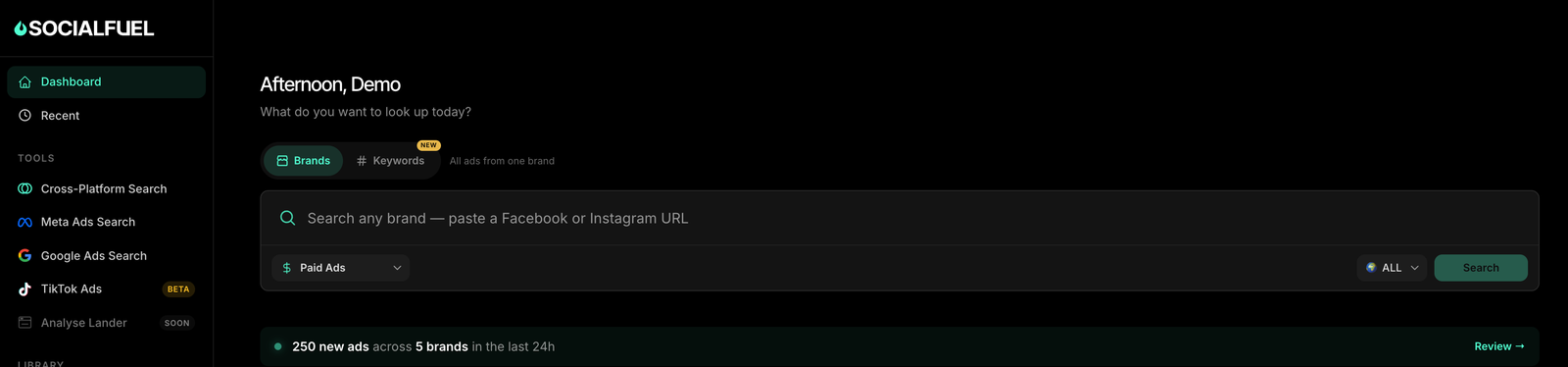
Every problem above is a resolution problem: matching a brand you can name to the Pages, countries and platforms where their ads actually live. That is exactly what we built SOCIALFUEL to do.
You type a brand, a keyword or a URL. It resolves the advertiser, pulls their live ads across Meta, Instagram, Google and TikTok in one search, and lets you sort by Longest so the survivors sit at the top instead of whatever launched yesterday. From there you can decode any individual ad — its hook, angle, offer and likely audience — rather than staring at a wall of creatives trying to infer the strategy yourself.
Free to start, no credit card, no ad-account connection required.
Frequently asked questions
Why can't I see my competitor's Facebook ads?
Usually the country filter. The Meta Ad Library shows ads delivered to a country you select, not ads run by a company based there, and ad_reached_countries is a required parameter in Meta's own API — so every search is a country search. The next most common causes are searching a website address instead of a Facebook Page name, and leaving the ad category on "Issues, elections or politics" instead of "All ads".
Does the Facebook Ad Library show all ads?
No. It shows ads currently running on Meta technologies, in the country you have selected. Meta describes it as a place where "people can search for all active ads running across products from Meta". It does not cover Google, TikTok or any other network, and it does not retain commercial ads once they stop.
Can you see a competitor's old or paused Facebook ads?
Not for commercial brands. Ads about social issues, elections or politics "are visible whether they're active or inactive and are stored in the Ad Library for 7 years", but ordinary commercial ads disappear when they stop. The exception is ads that delivered an impression in the EU, which Meta archives for one year after their last impression. If you want history for a commercial advertiser, you have to be capturing it while it runs.
How do I find a competitor's ads if the search box won't find their Page?
Go to their Facebook Page directly, open the Page transparency section, and follow the link through to the Ad Library. That resolves the exact Page, which removes ambiguity from spelling, duplicate regional Pages and impersonator accounts.
Why does a competitor show only a few ads when I see them everywhere?
Their ads are probably running under Pages that are not theirs. Creator and partnership ads are delivered through the creator's account, and agencies sometimes run from their own assets. Searching a distinctive phrase from the ad copy, rather than the brand's Page, surfaces ads wherever they are running from.
Can I see how much a competitor spends on Facebook ads?
No. Meta documents spend and impressions as "Available only for POLITICAL_AND_ISSUE_ADS". Across 2,108 tracked Meta ad records from 21 brands measured on 5 August 2026, zero carried a spend value and one carried an impressions value of 0 to 999. Any competitor spend figure you see from a third-party tool is modelled, not reported.
Is it legal to look at competitor ads?
Yes. Ad libraries are published deliberately as transparency tools and require no login for basic access. Copying a competitor's creative is a different question — that is a copyright matter. Study the structure and write your own.
Do this for your own market
Every fix above works with free public tools and enough patience. The reason people give up is that doing it properly means repeating the same eight checks across three ad libraries and every country that matters, every time you want to know what changed.
SOCIALFUEL collapses that into one search and keeps watching afterwards, so ads that vanish from the Ad Library do not vanish from your record. If you are weighing up options, we have compared the field in best ad spy tools, with direct write-ups for Foreplay, Adspo and Konvert.
About the author
Joel Helou is the founder of SOCIALFUEL, a growth agency that manages paid social and search campaigns for ecommerce and DTC brands, and the creator of socialfuel.io. He has spent the past decade buying media for brands across apparel, supplements and consumer goods, and now builds the tooling his own team uses to decode why competitors' ads work. The ad-record figures in this article were measured on 5 August 2026 through that platform.