
What makes a Facebook ad actually win?
Winning Facebook ads share three measurable traits: high engagement rates, strong conversion rates, and a return on ad spend that justifies every dollar. They stop the scroll, deliver a clear value proposition, and send traffic to a landing page that matches the ad’s promise. That last part matters more than most marketers realize. Driving traffic to a dedicated landing page rather than a homepage is one of the clearest separators between ads that convert and ads that just get clicks.
The core elements of a high-performing ad look like this:
- Strong creative hook that grabs attention in the first three seconds (video) or the top third of the image (static)
- Clear value proposition stated in the headline, not buried in the body copy
- Targeted messaging written for a specific audience segment, not a broad crowd
- Landing page alignment where the ad’s offer and visual language carry through to the destination
- Data-backed results validated against primary metrics like CPA, ROAS, or CTR depending on campaign objective
Facebook’s relevance score (now broken into quality, engagement rate, and conversion rate rankings) signals whether your creative resonates with the audience you’re targeting. Video and UGC formats consistently lower cost per lead and increase purchase rates compared to static ads, according to industry data, making them more effective than polished brand ads.
Creative strategies that drive winning Facebook ad campaigns

Creative is the new targeting. Granular audience hacks matter less than they did three years ago; what moves the needle now is a hook that earns attention before the algorithm even has a chance to optimize delivery.
Formats and tactics that consistently outperform:
- Short-form vertical video for Reels and Stories, optimized for sound-off viewing with text overlays
- Authentic UGC-style content where real people demonstrate the product in context, not a studio
- GIF ads that outperform static images in CVR across multiple campaign types
- Carousel ads for multi-product showcases or sequential storytelling
- Emotional triggers paired with social proof: a customer result, a star rating, a concrete before-and-after
Copy mechanics that close: urgency cues (“48-hour offer”), specific numbers (“lose 12 lbs in 30 days”), and a CTA that tells the reader exactly what happens next. Vague CTAs like “Learn More” underperform against direct ones like “Get Your Free Quote” when the audience is warm. Personalized ad creatives written for a specific segment consistently outperform generic, one-size-fits-all copy.
Pro Tip: Test one variable at a time. Change the hook image while keeping copy identical, or swap the headline while keeping the visual constant. Multi-variable tests produce noise, not signal. Iterate in single steps and let data tell you what to scale.
Real campaign examples and what made them work
The most instructive Facebook ad examples come from campaigns with documented results. UGC and video ads significantly lower cost per lead and increase purchase rates compared to static ads, as demonstrated by real campaign results such as 2.6x more leads and 34% higher CVR for UGC video in lead generation, and 4x more leads with 174% higher CVR for video over static in SaaS campaigns.
What these campaigns share: a hook built around a relatable problem, copy that leads with the outcome rather than the feature, and a landing page that mirrors the ad’s visual and messaging DNA. Audience segmentation also played a role. Each campaign targeted a defined segment rather than a broad interest pool, which kept relevance scores high and CPMs lower.
Campaign objectives shape creative decisions too. Awareness campaigns prioritize thumb-stopping visuals and brand recall. Lead gen campaigns front-load the offer and use friction-reducing CTAs. Conversion campaigns lean on social proof and urgency to push warm audiences over the line.
How to budget and scale without breaking what works
Premature scaling is one of the most common ways marketers destroy a winning campaign. When you double a budget overnight, you force Facebook’s algorithm to find a new audience pool fast, often at the cost of the delivery efficiency it spent days building.
Budget and scaling best practices:
- Start with a minimum viable budget that gives the algorithm enough data without overspending before signals are validated
- Respect the learning phase. Disturbing campaigns during this period resets optimization and wastes spend. Facebook needs a sufficient number of conversion events per ad set before delivery stabilizes
- Scale in 20–30% increments every few days, not in one jump
- Duplicate winning ad sets rather than editing live ones, to preserve the original’s performance history
- Allocate budget across funnel stages: prospecting campaigns for cold audiences, retargeting campaigns for site visitors and video viewers
The set-it-and-forget-it mentality kills campaigns slowly. Check performance every 3–4 days during active scaling, and pause ad sets that show rising CPA without a corresponding improvement in downstream metrics.
Measuring and refining your campaigns over time
The metrics that matter depend on where in the funnel you’re measuring. CTR tells you whether your creative earns the click. Conversion rate tells you whether your landing page earns the sale. Confusing the two leads marketers to fix the wrong problem: rewriting ad copy when the real issue is a slow-loading landing page.
Key metrics by funnel stage:
- Top of funnel: CPM, CTR, video view rate, hook rate (percentage who watch past 3 seconds)
- Mid funnel: Cost per landing page view, add-to-cart rate, lead form completion rate
- Bottom of funnel: CPA, ROAS, purchase conversion rate
A/B testing methodology matters here. Testing one variable at a time is the only way to know what actually drove a performance change. Run each test until you have statistically meaningful data, not just a few days of results.
The Meta Pixel is non-negotiable for conversion tracking. Place it in the head section of every page on your site, then set up standard events (ViewContent, AddToCart, Purchase) so Facebook can optimize delivery toward users most likely to complete the action you care about. Without pixel data, you’re running blind on conversion-optimized campaigns.
Ad fatigue shows up as rising frequency with declining CTR. When an ad’s frequency climbs past 4–5 and CTR drops, refresh the creative before performance craters. Catching fatigue early costs far less than rebuilding a campaign from scratch.
How to find and research winning ads in your market
The Facebook Ad Library is the starting point. Search any brand or keyword to see every active ad, then filter by country, date range, and ad type. It won’t show you performance data, but it reveals what competitors are running and how long they’ve been running it. Longevity is a proxy for performance: ads that have been live for weeks are likely generating results.
For deeper analysis, Socialfuel’s AI-powered platform lets you search any brand, keyword, or URL to surface winning ads across Facebook, Instagram, and beyond, then decode the hook, copy angle, and creative strategy behind each one. You can also use the Meta Ad Library guide to build a systematic research workflow.
Build a winner profile document for every ad you identify as a top performer:
- Format (video, GIF, static, carousel)
- Hook style (problem statement, bold claim, question, demonstration)
- Messaging angle (pain-focused, benefit-focused, social proof-led)
- Audience segment and placement where it delivered best
- CTA language and offer framing
Pro Tip: Analyze frequency and placement performance separately. An ad crushing it in Feed may underperform in Stories because viewing behavior is faster and more casual. A placement-specific version of your winner often outperforms the original in that context.
Use your winner profile as a creative brief, not a copy template. Replicating the same ad leads to fatigue. Replicating the same principles with fresh angles, new hooks, and updated visuals compounds results over time. You can also spy on competitors systematically to build a swipe file of angles worth testing in your own account.
Staying compliant and avoiding common policy pitfalls
Facebook’s advertising policies are strict, and violations can get ads rejected or accounts suspended without much warning. The most common pitfalls fall into a few categories.
Prohibited content includes ads that make before-and-after health claims, imply personal attributes (weight, financial status, health conditions) about the viewer, or use misleading pricing. Even a headline like “Struggling with debt?” can trigger a policy flag for implying a personal financial attribute.
Restricted categories such as financial products, alcohol, supplements, and housing require additional compliance steps. Ads in these categories must meet both Facebook’s policies and applicable U.S. regulations, including FTC disclosure requirements for endorsements and testimonials.
Landing page compliance is often overlooked. Facebook reviews the destination URL, not just the ad creative. A landing page with missing privacy policies, broken links, or content that contradicts the ad will get the campaign rejected. Keep your landing page consistent with the ad’s offer and ensure your privacy policy is linked and current.
Common technical mistakes: using before-and-after images in the same creative, making income or weight-loss guarantees, and running ads with more than 20% text coverage on images (though this rule is now enforced less rigidly, it still affects delivery). Review the Meta Advertising Standards before launching any campaign in a sensitive category, and use the Meta Ads management resources available to stay current on policy updates.
Discover winning ads faster with Socialfuel
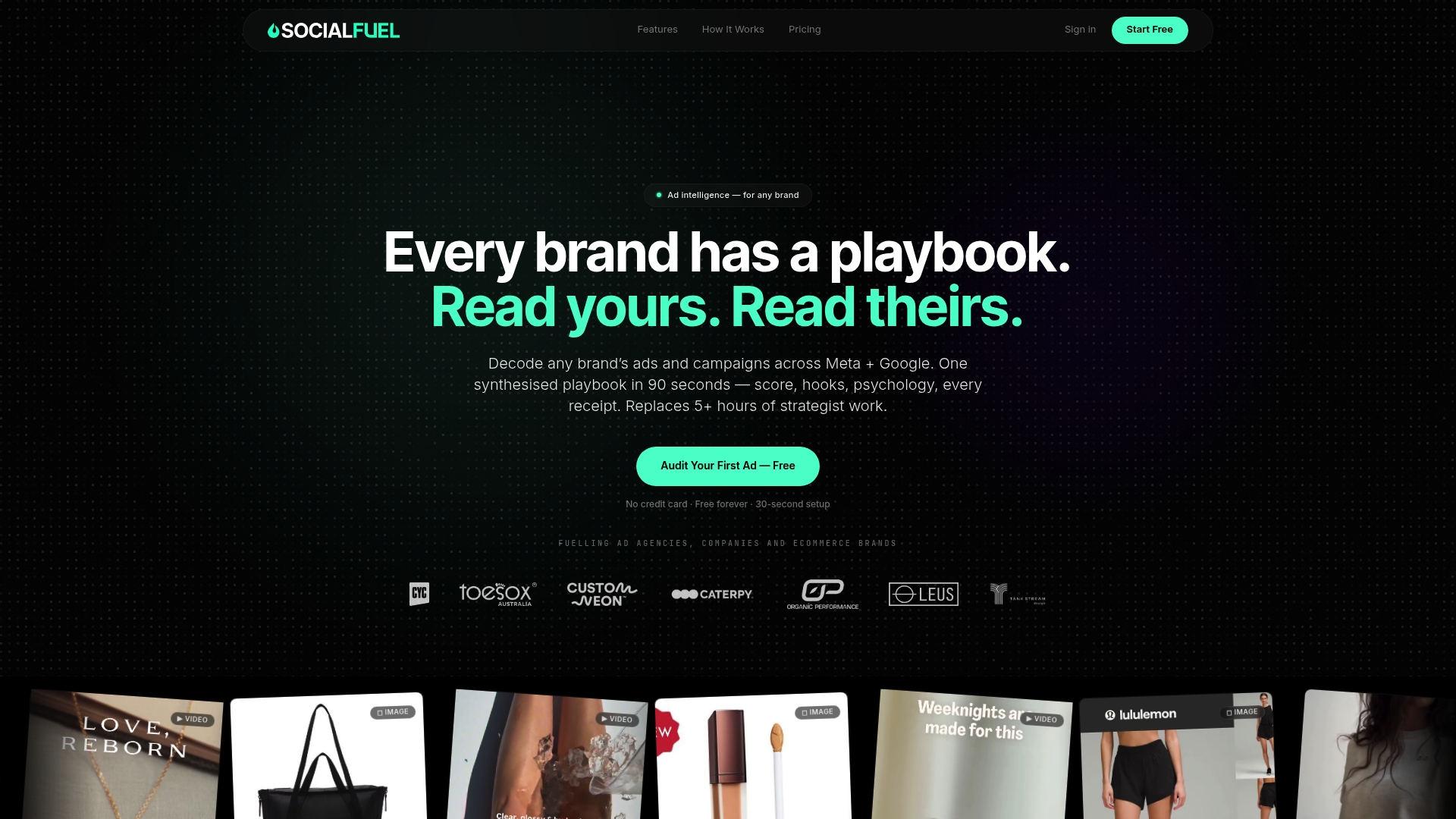
Stop guessing what works. Socialfuel’s AI-powered ad intelligence platform lets you search any brand, keyword, or URL to find winning Facebook ads, decode their hooks and creative strategy, and build your own competitive playbook. From winner scores to exportable briefs, every feature is built to help you ship higher-converting campaigns faster.
Start finding winning ads with Socialfuel today.
Key Takeaways
Winning Facebook ads combine a strong creative hook, precise audience targeting, and validated performance data before any scaling begins.
| Point | Details |
|---|---|
| Hook quality drives everything | The first three seconds of video or top third of a static image determines whether your ad earns attention. |
| UGC and video outperform static | Video and UGC formats consistently lower cost per lead and increase purchase rates compared to static ads, as confirmed by multiple campaign case studies. |
| Respect the learning phase | Facebook needs roughly 50 conversion events per ad set before delivery optimizes; scaling too early resets progress. |
| Test one variable at a time | Changing a single element per test is the only reliable way to know what drove a performance change. |
| Build a winner profile | Documenting format, hook, messaging angle, and placement for top performers creates a replicable creative brief. |