
Why competitive intelligence advertising is your sharpest edge in 2026
Competitive intelligence advertising (CI) is the practice of systematically collecting and analyzing competitor ad data from publicly available sources to make smarter, faster campaign decisions. Not guesswork. Not gut instinct. Actual data on what hooks competitors are running, which channels they’re investing in, and where their creative strategy has gaps you can exploit.
The urgency in 2026 is real. Digital media now accounts for 69% of total ad spend, with retail media growing at 12.3% annually. The ad ecosystem has never been more complex or more competitive. Brands that rely on intuition alone are already losing ground to teams running structured intelligence programs.
Here’s why CI belongs in every marketer’s core workflow:
- Replaces assumption-based planning with real competitor data
- Reveals which channels and creatives are actually working in your category
- Identifies underserved audience segments before rivals do
- Reduces wasted spend by benchmarking against proven strategies
- Keeps your team proactive rather than reactive to market shifts
Socialfuel is built specifically for this kind of intelligence work, giving marketers a direct window into competitor ad creative, hooks, and strategy across Facebook, Instagram, Google, and YouTube.
Table of Contents
- Which digital channels deserve your CI focus in 2026?
- How to conduct ethical and effective competitive intelligence
- How AI and human expertise work together in advertising intelligence
- How to spot market gaps and differentiate your campaigns
- Methods for collecting and validating competitive intelligence data
- Tools and platforms for gathering competitive ad data
- What successful competitive intelligence looks like in practice
- KPIs that tell you whether your CI program is working
- How to wire CI insights into your creative and media planning
- Socialfuel gives you the intelligence your campaigns need
- Key Takeaways
Which digital channels deserve your CI focus in 2026?
Not every channel deserves equal attention. Retail media, CTV, video, social, and digital out-of-home are the primary growth drivers this year, and your competitive monitoring should mirror that priority stack.
Retail media’s 12.3% growth rate signals a structural shift toward commerce-led media. Brands that ignore what competitors are doing on Amazon, Walmart Connect, and Instacart are flying blind on one of the fastest-moving channels in advertising. CTV is accelerating too, with premium sports rights and ad-supported streaming expanding inventory at a pace that rewards early movers.
Social remains the volume play. The IAB 2026 Outlook Study projects social and CTV to lead growth again this year, driven by audience consumption shifts and stronger measurement capabilities. Search, meanwhile, is moderating as AI-powered and social search increasingly fragment traditional query behavior, making a multi-channel intelligence strategy non-negotiable.
Channels to monitor closely in 2026:
- Retail media networks (on-site and off-site placements)
- Connected TV and streaming video
- Social platforms, especially short-form video formats
- Digital out-of-home
- Paid search, with attention to AI-generated answer placements
How to conduct ethical and effective competitive intelligence
CI and industrial espionage are not the same thing. Competitive intelligence relies exclusively on publicly accessible data and operates fully within legal boundaries. Ad creatives, visible placements, campaign reach estimates, and public messaging are all fair game. Hacking, misrepresentation, or accessing proprietary systems is not CI. It’s a legal liability.

Effective CI starts with a clear objective. Are you trying to reduce cost per acquisition, find a new audience angle, or decode a competitor’s creative formula? Defined goals keep your data collection focused rather than sprawling. From there, structured and consistent data collection frameworks are what separate real intelligence programs from one-off competitor checks.
Best practices for ethical, effective CI:
- Collect only from publicly available sources: ad libraries, landing pages, social profiles
- Apply SWOT analysis and competitor benchmarking to structure findings
- Analyze creative tone, calls to action, and visual patterns across competitor ads
- Assess channel distribution to spot where rivals are over or underinvesting
- Run a full competitive analysis at least annually, with lighter monthly refreshes
- Document findings in a shared competitive playbook your whole team can act on
Pro Tip: Track how long a specific competitor hook stays active. A creative that runs for weeks without rotation is almost always a winner. That longevity tells you more about performance than impression estimates ever will.
How AI and human expertise work together in advertising intelligence
The IAB 2026 Outlook Study is direct on this: AI is moving from experimentation to core infrastructure in media buying and campaign execution. Two-thirds of buyers are now focused on agentic AI for ad buying, and algorithmically enabled ad spend is forecast to reach 75% of total ad spend by 2028. That’s not a trend to watch. It’s a shift to build around.
Where AI earns its place in CI is in speed and pattern recognition: scanning thousands of active ads, flagging creative changes, and surfacing performance signals faster than any manual process. Socialfuel’s AI-powered platform does exactly this, decoding the hooks, copy angles, and psychological triggers behind competitor ads and packaging them into briefs your creative team can act on immediately.
Human oversight still matters, though. Buyers retain control over relationship-based decisions and high-stakes negotiations, delegating analytical and optimization tasks to AI while keeping governance in human hands. That hybrid model is where the real edge lives.
- Use AI to monitor competitor creative at scale and trigger alerts on changes
- Apply human judgment to interpret context, brand positioning, and strategic intent
- Integrate weekly creative digests and automated alerts to avoid analysis paralysis
- Pair AI-generated insights with qualitative review before acting on them
The 2026 reality: Success hinges on combining AI-driven automation with human oversight to navigate AI-shaped consumer journeys. Neither alone is enough.
How to spot market gaps and differentiate your campaigns
Copying a competitor’s creative is the floor, not the ceiling. The real payoff from CI is spotting white space and market gaps that competitors haven’t addressed, then building campaigns that own that territory before anyone else does.
A competitive matrix is the most practical tool for this. Plot competitors on two axes (price vs. quality, emotional vs. rational messaging, broad vs. niche targeting) and the gaps become visible. Audience segments nobody is speaking to, emotional angles nobody is running, channels where spend is thin relative to audience size. These are your openings.
Differentiation comes from understanding market dynamics and deciding where to compete versus where to diverge. That decision should be grounded in data from your CI program, not a hunch about what feels different. Check out Socialfuel’s guide on how to spy on competition for a practical framework on mapping competitor creative territory.
Approaches for applying CI to stand out:
- Build a positioning map to visualize where competitors cluster and where gaps exist
- Identify audience segments competitors are underserving or ignoring entirely
- Analyze competitor messaging for emotional triggers they’re not using
- Find channels where rivals underinvest relative to audience opportunity
- Align gap findings directly with your creative brief and media plan
Methods for collecting and validating competitive intelligence data
Raw data without validation is just noise. Effective CI programs layer multiple collection methods and cross-reference findings before acting on them.
Primary collection sources include public ad libraries (Meta Ad Library, Google Ads Transparency Center), competitor landing pages, social media profiles, and third-party ad monitoring platforms. Secondary sources include industry reports from IAB and Dentsu, analyst commentary, and market research for advertising from bodies like the U.S. Small Business Administration. Validation means checking a finding across at least two independent sources before treating it as a signal worth acting on.
Frequency matters as much as method. A full competitive analysis of products, pricing, promotion, and positioning should run at least annually. Campaign-level monitoring, where you track active creatives and messaging shifts, works best on a rolling weekly basis.
Tools and platforms for gathering competitive ad data
The right tool depends on what layer of intelligence you need. For ad creative and campaign analysis, AI-powered ad intelligence platforms like Socialfuel let you search any brand, keyword, or URL to surface active ads across Facebook, Instagram, Google, and YouTube, complete with hook analysis, copy breakdowns, and winner scores.
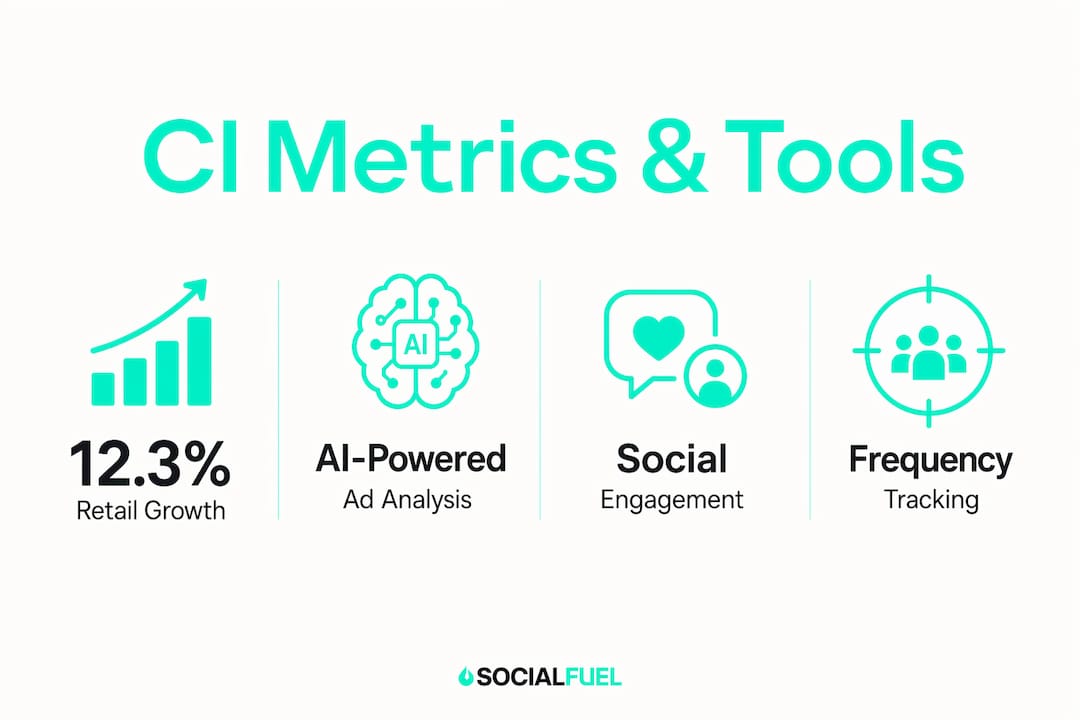
For social monitoring and engagement tracking, dedicated social media analytics tools surface competitor content performance and audience interaction patterns. Website change tracking tools monitor competitor landing pages and flag copy or positioning updates in real time. SEO and SEM platforms provide keyword overlap analysis and paid search visibility data. The role of data in marketing strategy has expanded to the point where no single tool covers every layer, making a stacked approach the standard for serious CI programs.
What successful competitive intelligence looks like in practice
Consider a direct-to-consumer brand preparing a Q4 push. Rather than guessing at creative angles, their team uses Socialfuel to pull every active ad from three key competitors, filter by run duration, and identify the hooks that have been live the longest. Those long-running creatives reveal which emotional angles and offer structures are converting. The team builds their own briefs around the gaps: an audience segment competitors aren’t addressing and an emotional angle none of them are running.
The result is a campaign that doesn’t just compete on the same ground. It occupies territory the competition left open. This is what competitive intelligence turns into when it’s applied systematically: precision over assumption, differentiation over imitation.
KPIs that tell you whether your CI program is working
Measuring CI impact requires connecting intelligence inputs to campaign outputs. The metrics that matter most:
| KPI | What it measures |
|---|---|
| Share of voice | Your brand’s ad presence relative to competitors in a given channel |
| Creative win rate | Percentage of tested hooks that outperform your control |
| Cost per acquisition vs. category benchmark | Whether your targeting efficiency is improving relative to rivals |
| Hook longevity | How long your top creatives run before performance drops |
| Audience overlap reduction | How much you’ve shifted spend toward underserved segments |
Track these on a monthly cadence and tie each shift back to a specific CI finding. That connection is what justifies the investment and sharpens the next round of analysis.
How to wire CI insights into your creative and media planning
Intelligence that stays in a spreadsheet doesn’t move campaigns. The goal is to make CI findings a direct input to your creative brief and channel plan, not a separate research exercise that runs in parallel.
Practically, this means your creative team reviews the competitive playbook before writing any new concepts. Hooks competitors are running heavily should be noted and either avoided (to differentiate) or tested with a sharper angle. Channel distribution data from your CI program should feed directly into your media plan, shifting budget toward channels where competitors are underinvesting. Socialfuel’s exportable briefs and playbooks make this handoff concrete, giving designers and copywriters a structured starting point grounded in real market data rather than internal assumptions.
Pro Tip: Build a standing “competitor creative swipe file” updated weekly. When your team sits down to brief a new campaign, the file gives them an immediate read on the current creative DNA of your category.
Socialfuel gives you the intelligence your campaigns need
Every insight in this article requires one thing to execute: fast, reliable access to what competitors are actually running. That’s exactly what Socialfuel delivers.
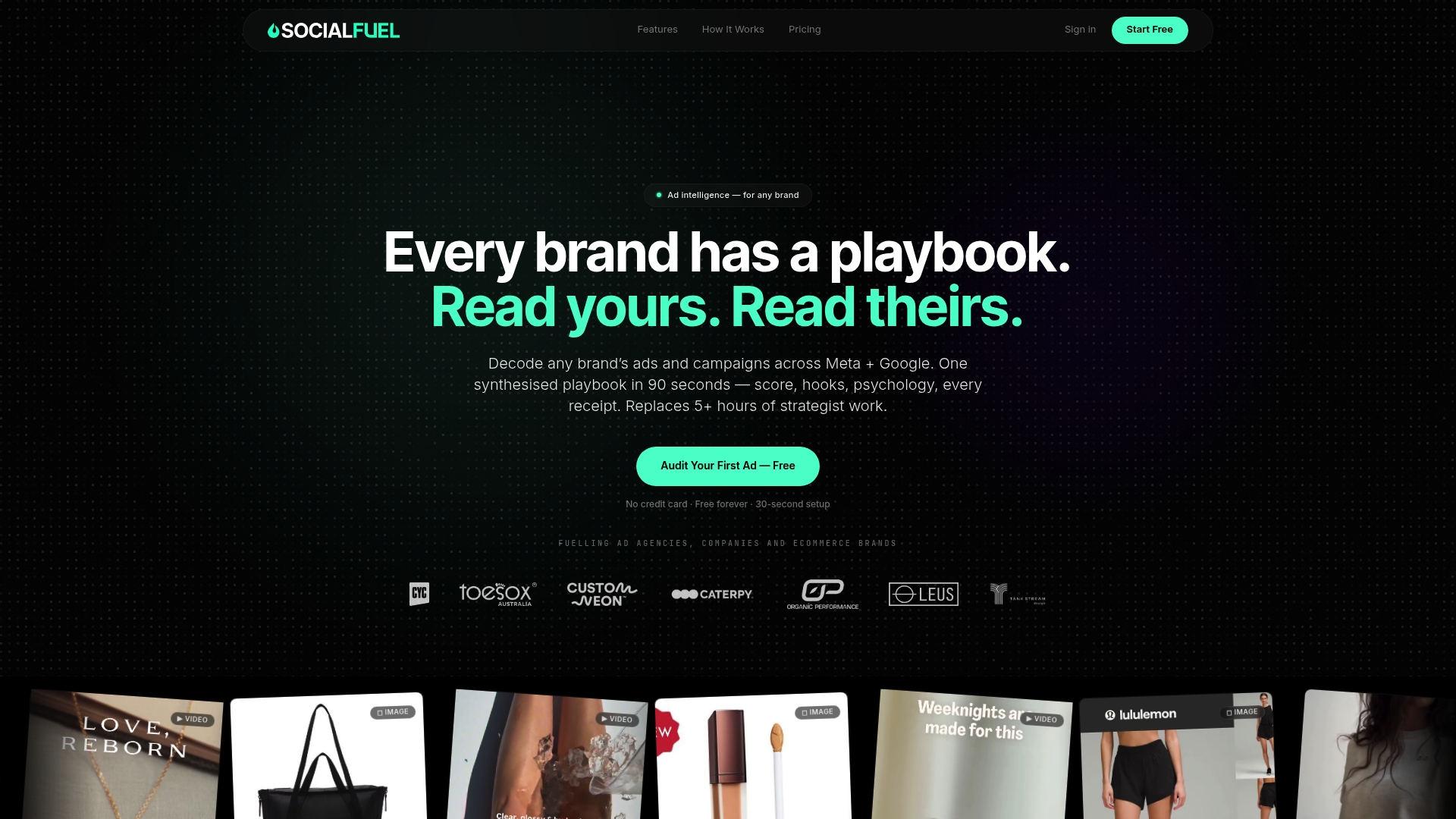
Search any brand, keyword, or URL to pull active ads across Facebook, Instagram, Google, and YouTube. Decode the hook, copy angle, and creative strategy behind any ad in seconds. Set up brand watching with automatic alerts so you never miss a competitor’s new campaign. Export client-ready briefs and playbooks your team can act on the same day. Whether you’re a solo marketer, an agency managing multiple accounts, or an eCommerce brand scaling spend, Socialfuel’s AI-powered platform turns competitor data into a concrete creative and media advantage. Start your free trial and see what your competitors are running right now.
Key Takeaways
Competitive intelligence advertising shifts campaign decisions from intuition to precision by decoding competitor strategy with publicly available data and AI-powered analysis.
| Point | Details |
|---|---|
| Digital dominates ad spend | Digital media now accounts for 69% of total ad spend as of May 2026, making it the primary CI focus area. |
| Retail media leads channel growth | Retail media is growing at an annual rate of 12.3% in 2026, faster than any other digital channel. |
| AI plus human oversight wins | The IAB confirms success in 2026 depends on pairing AI automation with human governance. |
| Hook longevity beats impression counts | A competitor creative running for weeks signals a winner more reliably than impression volume. |
| Socialfuel accelerates CI execution | Socialfuel lets marketers search, decode, and brief competitor ads across major platforms in one workflow. |