
Meta Collection Ads are mobile-only ad units that pair a hero image or video with a four-tile product grid, opening into a full-screen Instant Experience hosted inside Facebook or Instagram. No browser handoff. No friction. Just an immersive in-app storefront that loads roughly 15 times faster than a standard mobile website. For eCommerce brands, that speed difference alone changes how shoppers engage.
Key reasons to run them in 2026:
- Middle-funnel power: They build brand familiarity before asking for the sale, which makes downstream retargeting far more efficient.
- Immersive format: The Instant Experience keeps users inside the app, reducing drop-off from slow external pages.
- Catalog integration: Tiles auto-populate from your Meta Commerce Manager feed, so inventory stays current without manual updates.
- Proven brand lift: Case studies show a 31-point lift in ad recall and a 17.5-point lift in brand favorability.
- Visual range: A single ad unit communicates brand story and product depth simultaneously.
What makes Meta Collection Ads work in your marketing funnel
The format has three moving parts: the hero creative, the product tile grid, and the Instant Experience. Each one does a different job.
The hero image or video is the scroll-stopper. Video covers run up to 60 seconds, autoplay muted, and must hook the viewer in the first three seconds. Images use a 1:1 or 1.91:1 aspect ratio at a minimum of 1080 x 1080 pixels. Below the hero, four square tiles either pull live from a connected product catalog or display hand-selected images. If your catalog has more than four items, Meta picks the top four predicted to perform for that specific viewer.
The Instant Experience is where the real engagement happens. It opens on tap, loads inside the app, and functions as a mini storefront. Templates include Storefront, Lookbook, Customer Acquisition, and Storytelling. Each carries modules for hero blocks, product grids, text, buttons, and full-bleed images.
Where Collection Ads sit in the funnel: They are primarily a middle-funnel consideration tool, not a direct response format. Audi’s Collection Ads, for example, drove a 31-point lift in ad recall and a 17.5-point lift in favorability without requiring an immediate purchase. That is the format doing exactly what it is designed to do.
Technical specs at a glance:
- Primary text: 125 characters recommended
- Headline: 40 characters
- Image file: JPG or PNG, max 30 MB
- Video file: MP4, MOV, or GIF, max 4 GB
- Minimum catalog size: 4 products to populate the grid
How to create Collection Ads that actually perform
Setup starts in Meta Ads Manager, but the real work happens before you open it.
Before you build:
- Upload your product catalog to Meta Commerce Manager via Shopify, WooCommerce, or a manual CSV.
- Confirm you have at least four product images. Brands with eight or more products get significantly more visual variety.
- Define your campaign objective first. Collection Ads support Sales, Traffic, Conversions, and Store Traffic. Awareness and Reach do not support the format.
Step-by-step setup:
- Create a new campaign and select your objective.
- At the ad set level, leave placements on Advantage+ or manually select Facebook feed and Instagram feed. Collection only serves on mobile.
- At the ad level, choose “Collection” as the format.
- Upload your hero creative. Video outperforms static for cold audiences because it adds context before the product grid appears.
- Connect your product catalog and choose a product set, either all products or a filtered segment.
- Build your Instant Experience. Start from a template, then customize with lifestyle imagery, product highlights, and a clear CTA.
- Set primary text and headline, then preview on mobile before publishing.
Creative recommendations:
- Lead with lifestyle video (15–30 seconds) showing products in context, not on a plain background.
- Include user-generated content (UGC) inside the Instant Experience. Testimonials alongside product images convert better than product-only layouts.
- Feature your best-selling or most visually compelling products in the four visible tiles, not a random catalog sample.
Pro Tip: Build a custom Instant Experience that matches the tone and narrative of your hero video rather than defaulting to the auto-populated catalog template. Brands that align the Instant Experience story with the hero creative consistently see stronger downstream conversion rates.
Audience targeting follows the same logic as any Meta campaign, but the format rewards differentiation. Cold audiences need brand education. Warm audiences and retargeting pools need proof and a clear offer. Budgets under $10,000 per month should focus on demand capture with tight targeting and proven unit economics before expanding into Collection Ads as a middle-funnel layer.

How to measure and optimize Collection Ads for real results
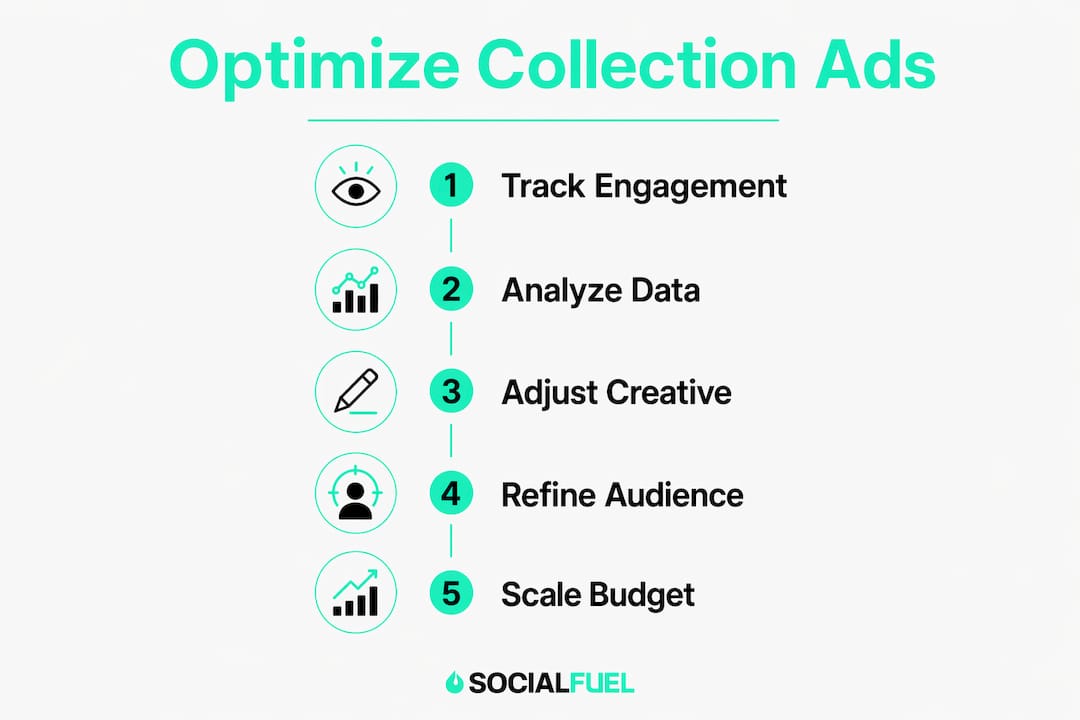
The biggest measurement mistake is treating click-through rate as the primary success signal. Optimizing solely on immediate CTR misses the format’s actual value, which shows up in downstream conversion efficiency, not in the first click.
Metrics that matter:
- Instant Experience open rate: Tracks how many ad tappers proceed to the full Instant Experience. This is your engagement quality signal.
- Click-through to website: The percentage of Instant Experience viewers who then visit your site.
- CPA and ROAS: Define your target CPA or ROAS before launch, not after. Without a pre-defined target, you cannot evaluate whether the campaign is working.
- Downstream conversion rate: Measure how Collection Ad exposure affects retargeting performance in the weeks that follow.
Use Meta Pixel and custom events to track engagement at each step: ad tap, Instant Experience open, and website purchase. Third-party attribution tools can clarify how Collection Ad exposures contribute to purchases that happen days after the initial interaction.
Build a weekly dashboard that shows both platform metrics for optimization decisions and business metrics like revenue and lifetime value for strategic ones. Evaluate performance over a 3-month window before making structural changes. Knowing what a good eCommerce conversion rate looks like for your category gives you a real benchmark to measure against.
Pro Tip: Set up a custom event specifically for “Instant Experience Open” in Meta Events Manager. This micro-conversion gives the algorithm a signal to optimize toward before a purchase event fires, which is especially useful in the early learning phase.
Examples of successful Meta Collection Ads campaigns
The strongest collection ad examples share one pattern: the hero creative and the Instant Experience tell the same story.
Ashley HomeStore ran Collection Ads that reached 3.26 million people and delivered an incremental ROAS and a substantial lift in sales. The format worked because the catalog depth matched the immersive browsing experience the Instant Experience provided.
Sephora used Collection Ads to drive a higher ROAS than previous digital campaigns, alongside a higher click-through rate and a an increase in reach. Beauty is a natural fit: high SKU count, strong visual appeal, and customers who want to browse before committing.
Audi proved the format works even without an immediate purchase option. Their campaign drove a 9.1% lift in site conversions, an 11.7% lift in lead form submissions, and the 31-point ad recall lift noted earlier. The Instant Experience functioned as a digital showroom, building consideration before the buyer ever contacted a dealer.
The common thread across these collection ads examples: none of them treated the format as a direct response tool. Each used it to deepen brand engagement first.
How Collection Ads integrate with Facebook Shops and Instagram Shopping
Collection Ads connect directly to Meta Commerce Manager, which is the same infrastructure that powers Facebook Shops and Instagram Shopping. That shared foundation means your product catalog, pricing, and inventory sync across all three surfaces without duplication.
When a shopper taps through your Instant Experience and lands on a product page, Facebook Shops can complete the transaction inside the app if you have checkout enabled. Instagram Shopping tags inside the Instant Experience Lookbook template let users tap directly to product detail pages. The result is a closed loop: discovery in the feed, consideration in the Instant Experience, and purchase without leaving Meta’s ecosystem.
For brands running Dynamic Product Ads alongside Collection Ads, the same catalog powers both. Collection Ads handle cold and warm consideration traffic. Dynamic Product Ads handle retargeting with personalized product recommendations based on browsing behavior. Running both from a single catalog keeps creative production manageable and ensures consistent product data across formats.
Targeting strategies that fit Collection Ads in eCommerce
Collection Ads reward audience segmentation more than most formats because the multi-step click path filters out low-intent users naturally.
Cold audiences: Use interest-based or broad targeting with a strong lifestyle hero video. The goal is brand introduction, not immediate conversion. Lookalike audiences built from your top purchasers work well here.
Warm audiences: Retarget website visitors and video viewers with a Collection Ad that features the products they browsed. Dynamic product grids personalize the tile selection automatically based on behavior signals.
Large remarketing pools: Brands with 100,000 or more monthly website visitors get the most from dynamic Collection Ads because Meta has enough behavioral data to personalize the grid at scale.
Catalog size matters: The format requires a minimum of four products, but it performs best with 50 or more SKUs. More catalog depth gives Meta’s delivery system more options to match products to individual viewer intent. Checking ads insights that move the needle by audience segment helps you identify which targeting layer is driving real downstream value versus surface-level engagement.
The real pitfalls most marketers hit with Collection Ads
The format is not complicated. The mistakes are.
Treating Collection Ads as direct response. This is the most common misread. Many marketers expect Collection Ads to function like bottom-funnel conversion ads and pull the format when ROAS looks low in the first two weeks. The format builds consideration. Its value shows up in retargeting efficiency, not in first-click ROAS.
Changing multiple variables at once. When you change creative, audience, and budget simultaneously, you cannot identify what caused a shift in results. Test one variable at a time.
Scaling before unit economics are proven. Increasing spend before you know your CPA targets are viable just accelerates losses. Prove the model at a smaller budget first.
Skipping the review cadence. Build weekly and monthly checkpoints into your process before launch. Strategies that go unreviewed do not improve.
Neglecting the Instant Experience design. Defaulting to the auto-populated catalog template leaves performance on the table. A custom layout aligned with your hero creative narrative consistently outperforms the default.
Key Takeaways
Meta Collection Ads perform best as middle-funnel brand-building tools that improve downstream retargeting efficiency, not as direct response formats optimized for first-click ROAS.
| Point | Details |
|---|---|
| Format specs | Hero creative at 1080 x 1080 px minimum; primary text 125 characters; headline 40 characters; video up to 60 seconds. |
| Funnel role | Collection Ads drive consideration and brand lift; Audi’s campaign showed a 31-point ad recall lift without requiring an immediate purchase. |
| Measurement | Define CPA and ROAS targets before launch; track Instant Experience opens as micro-conversions alongside website purchase events. |
| Catalog depth | A minimum of 4 products is required; 50 or more SKUs gives Meta’s delivery system enough range to personalize the tile grid effectively. |
| Socialfuel | Use Socialfuel’s AI ad intelligence to decode winning Collection Ad hooks, creative angles, and Instant Experience structures before building your own. |
What most guides get wrong about Collection Ads
The conventional wisdom says Collection Ads are a high-converting format. That framing sets up the wrong expectation. They are a high-engaging format, and the distinction matters more than most campaign managers realize.
When you measure a Collection Ad campaign against direct ROAS in the first 30 days, it will almost always look worse than a standard single-image conversion ad. The click path is longer. The friction is higher. Cold traffic takes more steps to reach the purchase. But that friction is doing something useful: it filters for intent. The users who tap through the hero, open the Instant Experience, browse the product grid, and then click to the website are warmer than anyone who clicked a standard ad. They have spent time with your brand. That time shows up in retargeting conversion rates weeks later, not in the initial campaign report.
The brands that get the most from Collection Ads treat them as an investment in audience quality, not a shortcut to immediate sales. They measure success over a 3-month window, track Instant Experience engagement as a leading indicator, and use the format to prime audiences for bottom-funnel campaigns that close efficiently.
Socialfuel gives you the creative intelligence to run better Collection Ads
Knowing the format is one thing. Knowing which hooks, hero creative angles, and Instant Experience structures are actually winning in your category right now is another problem entirely.
Socialfuel is an AI-powered ad intelligence platform built for exactly this. Search any brand, keyword, or URL to surface active Facebook and Instagram Collection Ads, then decode the creative strategy behind them: the hook, the angle, the product grid selection, the Instant Experience flow. You get winner scores, copy analysis, and exportable briefs you can hand directly to your creative team. Competitor brand watching sends you automatic alerts when rivals launch new campaigns, so you are never caught reacting late. For eCommerce marketers who want to build a real competitive playbook around Collection Ads, Socialfuel cuts the guesswork out of creative strategy.