
Find winning ads by scanning platform ad libraries for long-running creatives, extracting the repeatable angle behind each one, and validating that angle with a fast, low-budget test. The three highest-signal free sources are the Meta Ad Library, the TikTok Creative Center, and the Google Ads Transparency Center. For marketers who need to run this process at scale or across multiple verticals, Socialfuel automates the discovery, teardown, and briefing steps, so you can move from research to test in a single day.
Start here:
- Search a competitor or category keyword in the Meta Ad Library, filter to active ads, and sort by oldest start date.
- Pull the five teardown fields for every ad that has been running 30 days or longer: hook, promise, proof point, CTA, and visual style.
- Brief a creative variant around the extracted angle and put $50–$100 behind a 24–72 hour Stage A screen.
That loop, repeated weekly, is how media buyers build a swipe-file that actually converts.
Key Takeaways
The fastest way to find winning ads is to combine platform ad library research with a structured teardown process and a two-stage validation test, then automate the entire loop with an AI ad-intelligence tool.
| Point | Details |
|---|---|
| Longevity is the best free signal | Ads running multiple weeks with multiple active variants are your highest-priority research targets. |
| Five teardown fields per ad | Capture hook, promise, proof point, CTA, and visual style for every reference ad you save. |
| Two-stage testing speeds decisions | Stage A (24–72 hours, engagement signals) filters losers; Stage B (3–7 days, 25–50 conversions) confirms winners. |
| Angle over execution | Borrow the transferable message pattern; build all creative assets from scratch to avoid legal and performance risk. |
| Socialfuel automates the loop | Search any brand or keyword across five platforms, get AI teardowns and winner scores, and export briefs the same day. |
Table of Contents
- Where to find active and historical ads fast
- How to use the Meta Ad Library to spot likely winners
- What TikTok, Google, and YouTube ad libraries tell you
- What signals actually indicate a winning ad?
- A compact 1-week discovery to validate workflow
- How AI ad-intelligence accelerates discovery with Socialfuel
- Practitioner perspective: what actually separates fast learners from slow ones
- Socialfuel puts the full discovery workflow in one place
- Links and resources for ad library research
- Sources
Where to find active and historical ads fast
Not all ad sources are equal. Some show you what is live right now; others reveal historical patterns and estimated spend. Knowing which tool gives you which signal saves hours of dead-end searching.
- Meta Ad Library — Free, covers Facebook and Instagram, shows start dates and creative previews. No spend or CTR data, but longevity is a reliable proxy. Best for: conversion creative research across most ecommerce verticals.
- TikTok Creative Center — Free, shows trending creatives with view-count proxies and sound reuse data. Best for: spotting native UGC formats and short-form hooks before they saturate.
- Google Ads Transparency Center / YouTube — Free, shows active search and display ads with destination URLs. Best for: identifying in-market conversion advertisers and reading their landing-page strategy.
- Platform publisher pages — Brand Facebook pages and YouTube channels surface organic-looking ads that often mirror paid creative. Useful as a secondary check.
- Socialfuel exports — Paid, covers Facebook, Instagram, TikTok, Google, and YouTube in one search. Returns angle teardowns, winner scores, and exportable briefs. Best for: multi-platform research at volume or when you need analyst-ready outputs the same day.
When does a paid ad-intel tool become worth the cost? Once you are researching more than two or three verticals simultaneously, running a media-buying team, or need to track competitor creative changes automatically, the time saved on manual library searches alone justifies the subscription. A single social media analytics tool comparison can help you benchmark what you are getting for the price.
Pro Tip: Search category keywords, not just brand names. Searching “collagen supplement” instead of a specific brand surfaces emerging angle patterns across dozens of advertisers at once, which is far more useful than studying one competitor in isolation.
How to use the Meta Ad Library to spot likely winners
The single best free signal in the Meta Ad Library is ad longevity combined with multi-variant testing behavior. An advertiser running the same creative for 60 days, with four or five active variants, is almost certainly profitable. Nobody keeps spending on a loser for two months.
Step-by-step walkthrough
- Go to the Meta Ad Library and select your country and platform (Facebook or Instagram).
- Search a competitor brand name or a category keyword (e.g., “keto snacks,” “standing desk”).
- Toggle to Active ads only.
- Click “See ad details” on any promising creative to reveal the start date.
- Sort your mental shortlist by oldest start date first. Ads running 30–60+ days are your primary targets, per practitioner guidance.
- Note how many active variants exist for the same advertiser. Multiple variants running simultaneously signal active A/B testing, which means the advertiser found something worth iterating on.
The five teardown fields to capture per ad
For every ad that clears the longevity filter, document these five fields in a simple spreadsheet or angle-teardown doc:
- Hook (first 3 seconds or first headline): What stops the scroll?
- Promise: What outcome does the ad claim?
- Proof point: Testimonial, statistic, before/after, or authority signal?
- CTA: What action is requested and how urgent is the framing?
- Visual style: UGC, polished studio, static image, carousel, or motion graphic?
This framework, drawn from a structured ad analysis approach, lets you extract the transferable angle rather than copying the execution. The angle is the idea; the execution is the specific copy, footage, and design. You can legally borrow an angle. You cannot replicate copyrighted creative assets.
Pro Tip: After clicking through to a landing page, check the URL for UTM parameters. A UTM source of “fb” combined with a product-page destination (not a homepage) is a strong signal that this is a direct-response conversion ad, not a brand-awareness play. That distinction changes how you model your own test.
A deeper guide to winning Facebook ads covers additional filters and teardown templates if you want to go further with Meta-specific research.
What TikTok, Google, and YouTube ad libraries tell you
Each platform library surfaces different signals, and treating them interchangeably wastes time. Here is what each one actually reveals and how to read it.
TikTok Creative Center
- Filter by industry, objective, and region to surface top-performing creatives in your category.
- High view counts in the preview are a proxy for paid reach, not organic virality. Treat them as a directional signal, not a hard metric.
- Sound reuse is a meaningful cue: when a sound appears across many unrelated ads, it has proven scroll-stopping power.
- Format cues to prioritize: native UGC (shaky cam, direct-to-lens address, text overlays) consistently outperforms polished studio creative on TikTok. If a competitor’s top creative looks like it was filmed on a phone, that is intentional.
- Suggested test variation: UGC-style 15-second hook vs. a polished 30-second demo. Run both; the winner is rarely the one that looks more expensive.
Google Ads Transparency Center and YouTube
- Search a brand or keyword to see active search, display, and video ads.
- Check destination URLs. A direct product-page URL with a discount parameter signals a conversion-focused campaign. A brand homepage URL signals awareness spend.
- For YouTube, watch the first five seconds of any ad that has been running for several weeks. That opening is the hook the advertiser has already tested and kept. It is worth studying closely.
- Spotting in-market advertisers: if a brand is running both search and YouTube ads to the same product page, they are likely in a scaling phase, which means their creative is proven enough to justify cross-channel spend.
Platform differences matter for your validation plan. TikTok decisions move faster because view and engagement signals accumulate quickly. Meta decisions rely more on longevity and conversion data, which takes longer to read. For niche channel research, the Twitter ads library is worth a look as a supplementary source.
What signals actually indicate a winning ad?
The most reliable discovery proxy is longevity plus repeated variants plus multi-country scale. An ad running in three countries, with six active variants, after 45 days is about as close to a confirmed winner as you can get without seeing the advertiser’s dashboard. Proxy signals like these are more reliable than engagement alone when spend and CTR data are hidden.
Discovery signals to capture during research
- Ad start date and longevity: 30+ days is a signal; 60+ days is a strong signal.
- Number of active variants: More variants mean active testing and iteration, which implies a profitable base.
- Cross-country running: Multi-market spend suggests the angle translates beyond one audience.
- Destination URL type: Product page with an offer beats a homepage every time for conversion intent.
- Visible creative format: Note whether the format matches the platform’s native style.
- Observable offer: Free shipping, discount code, bundle, or free trial visible in the creative.
Validation metrics for testing
Once you have a reference angle, you need to validate it with your own creative. A two-stage testing approach is the fastest way to separate losers from contenders:
Stage A (24–72 hours): Screen for hook rate (what percentage of viewers watch past the first 3 seconds), CTR, and hold rate. These are fast-accumulating signals that tell you whether the angle earns attention. Cut anything that clearly underperforms your account baseline.
Stage B (3–7 days): For ads that clear Stage A, shift focus to CVR, CPA, and ROAS. The target is 25–50 conversion events to reach statistical confidence before scaling.
Common false positives to avoid
High engagement does not equal conversion. A funny video can rack up comments and shares while generating zero purchases. Paused campaigns sometimes reappear in library searches and look active. Vanity metrics like likes and saves are the weakest signal in the stack. Anchor your decisions to conversion-focused metrics whenever possible, and use engagement only as an early-stage screen, per this analysis framework.
For more on building image ads that convert, the format-specific signals differ from video and are worth reviewing separately.
A compact 1-week discovery to validate workflow
The goal of this workflow is to turn a discovered ad angle into a tested creative hypothesis within seven days, without burning through budget on guesswork.
Day-by-day plan
| Day | Actions | Artifact | Checkpoint |
|---|---|---|---|
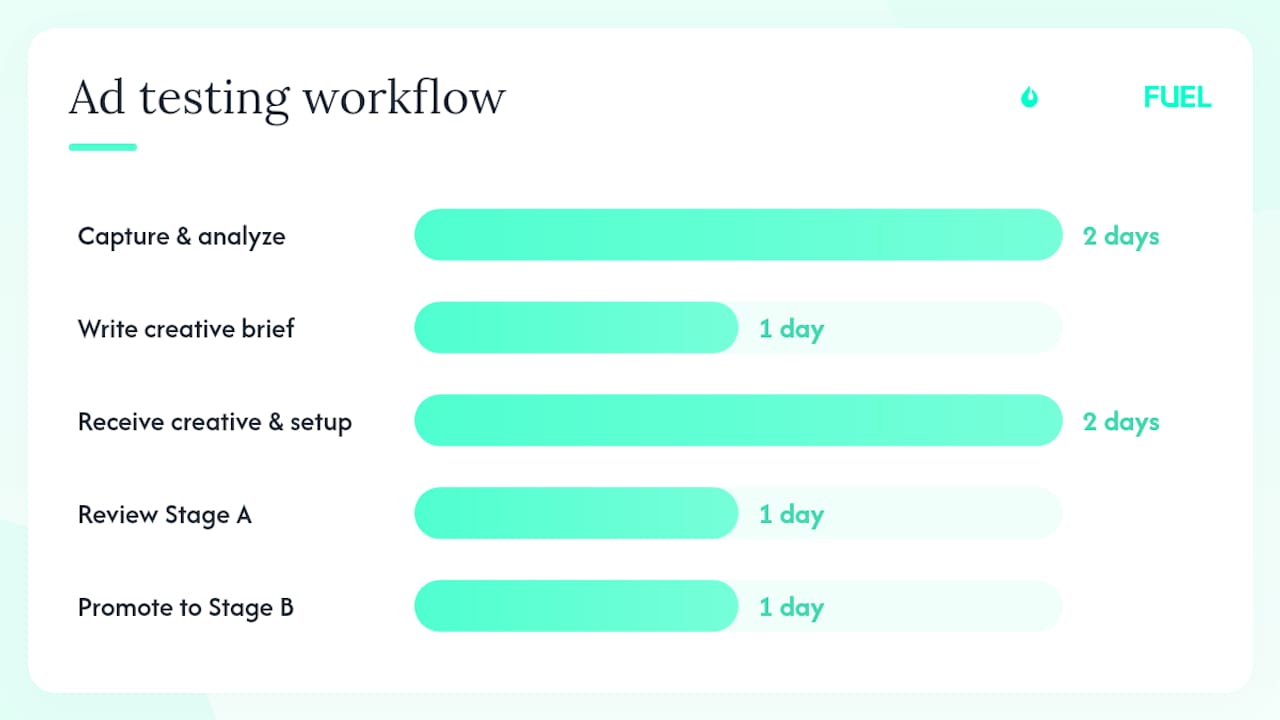
| Day 1 | Search Meta Ad Library + TikTok Creative Center; capture 5 long-running ads | Angle teardown spreadsheet (hook, promise, proof, CTA, visual) | At least 3 distinct angles identified |
| Day 2 | Analyze teardowns; identify the 1–2 angles most relevant to your product and audience | Prioritized angle shortlist with rationale | One primary angle chosen for testing |
| Day 3 | Write creative brief; brief designer or UGC creator | Creative brief doc | Brief approved; creative in production |
| Day 4–5 | Receive creative; set up Stage A test campaign | Live Stage A campaign | $50–$100/day budget, 24–72 hour window |
| Day 6 | Review Stage A metrics (hook rate, CTR, hold rate); cut losers | Stage A decision log | Clear pass/fail per variant |
| Day 7 | Promote Stage A winners into Stage B; set 3–7 day conversion window | Stage B campaign live | Target: 25–50 conversion events |
Budget guidance and decision rules
For Stage A, a daily budget of $50–$100 is enough to generate meaningful hook-rate and CTR signals within 48 hours on Meta or TikTok. The testing event for Stage A should be a high-volume proxy, such as add-to-cart or initiate checkout, rather than purchase, so signals accumulate faster.
For Stage B, shift the optimization event to purchase. The two-stage testing framework targets 25–50 conversions before making a scaling decision.
Decision rules:
- Promote: Stage B CPA is at or below your target, ROAS meets threshold, and you have 25+ conversions. Duplicate into a new campaign at 2x budget.
- Pause: Stage A hook rate is below your account average, or Stage B CPA is more than 30% above target after 50+ conversions.
- Confirm and iterate: Stage B shows a profitable CPA but low volume. Hold budget, test a second variant of the same angle with a different hook, and re-run Stage A.
How AI ad-intelligence accelerates discovery with Socialfuel
AI speeds what used to be seat-of-the-pants research into repeatable, exportable outputs you can act on the same day. Manual library searches take hours per platform. Socialfuel compresses that into a single search across Facebook, Instagram, TikTok, Google, and YouTube, then layers in creative analysis you would otherwise have to do by hand.
What Socialfuel exports and why each output matters
- Angle teardowns: Pre-built breakdowns of hook, message angle, visual format, and CTA for any ad you save. Eliminates the manual spreadsheet step entirely.
- Winner scores: An AI-generated signal that weights longevity, variant count, and creative patterns to surface the highest-probability winners in a search result.
- Creative briefs and playbooks: Exportable documents your creative team can brief from directly, cutting the gap between research and production.
- Brand-watch alerts: Automatic notifications when a competitor launches a new creative or scales an existing one, so you catch emerging angles before they saturate.
- Weekly creative digests: A curated summary of what is running and winning in your category, delivered without manual library checks.
Each of these outputs maps directly to a step in the discovery-to-validate workflow above. The teardown replaces Day 1–2 manual work. The brief replaces Day 3 drafting. The brand-watch alert replaces the weekly library check entirely.
A mini example of the workflow in practice
A DTC supplement brand wants to test a new creative angle. Using Socialfuel, a media buyer searches the category keyword “magnesium supplement” and filters for long-running ads. Socialfuel surfaces three ads that have been active for 45+ days across multiple countries, each with four or more variants. The AI teardown identifies a recurring angle: sleep quality as the primary promise, backed by a customer testimonial as proof. The media buyer exports a brief built around that angle, briefs a UGC creator, and has a Stage A test live within 48 hours of starting research. No competitor names are used in the creative; only the angle is borrowed.
Pro Tip: After pulling a Socialfuel teardown, always click through to the actual landing page manually. Check whether the page’s headline matches the ad’s promise. A mismatch between ad hook and landing-page headline is one of the most common reasons a “winning” reference ad fails to replicate in your own account. The angle may be proven; the landing page is your variable.
For a broader view of how to track competitor creative changes over time, the competitor analysis guide covers the full monitoring workflow.
Practitioner perspective: what actually separates fast learners from slow ones
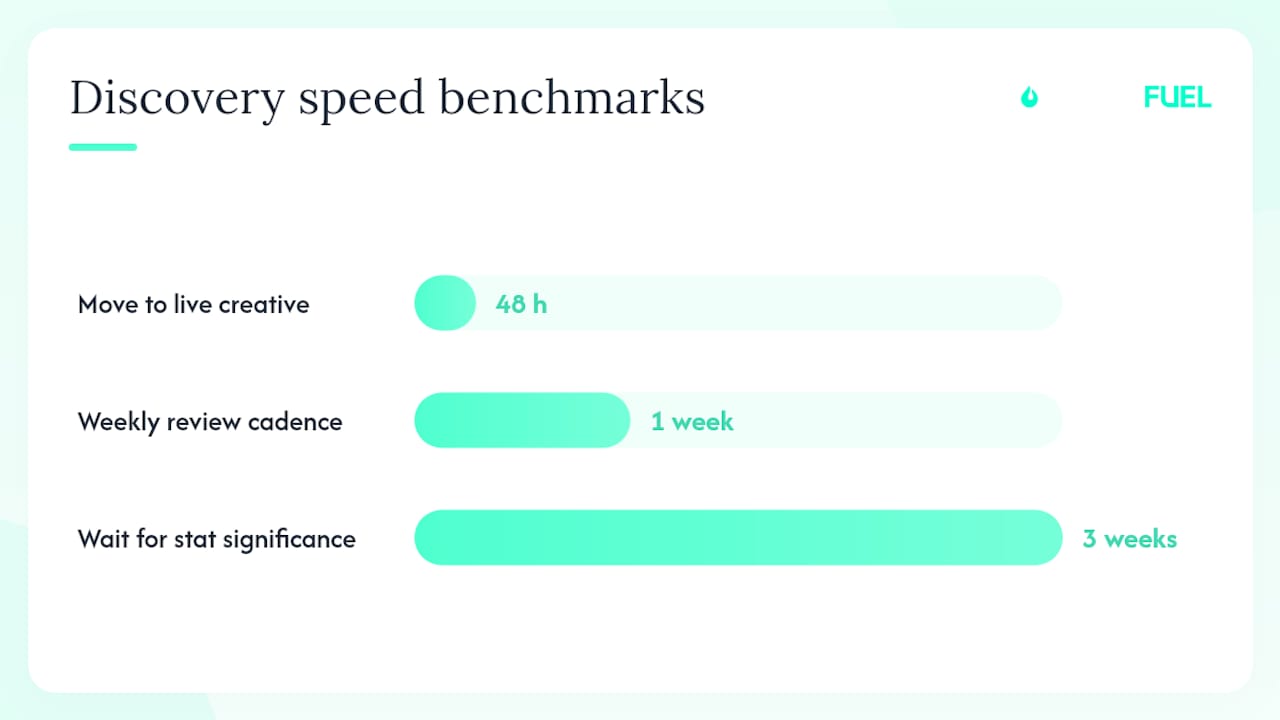
Speed beats statistical perfection at the discovery stage. The media buyers who find winning angles fastest are not the ones running the most rigorous tests. They are the ones who move from reference to live creative in 48 hours, collect a directional signal, and iterate. Waiting for statistical significance before cutting a Stage A loser is how you burn three weeks on a dead angle.
Here are the habits that separate fast learners:
- Prioritize angles with cross-category proof. If the same hook structure (e.g., “I was skeptical until…”) is working in skincare, supplements, and pet products simultaneously, it is a structural pattern worth testing in your category immediately.
- Delegate creative production, not creative direction. The angle brief is your job. The execution is the creator’s job. Conflating the two slows everything down and produces briefs that are either too vague or too prescriptive.
- Document every test, even the failures. A dead angle is still data. A swipe-file that includes failed tests tells you what your audience has already rejected, which is as valuable as knowing what works.
- Review your angle library weekly. Recurring archetypes, hooks that keep appearing across competitors, and formats that survive platform algorithm shifts are the patterns worth testing first. Practitioner guidance recommends a weekly cadence for exactly this reason.
- Copy the principle, never the execution. The most common mistake is lifting copy, visuals, or audio directly from a competitor’s ad. Beyond the legal exposure, it rarely works because the creative is already associated with another brand in the viewer’s mind. Extract the angle; build the creative from scratch.
The ads insights guide covers additional signal-reading frameworks for teams that want to go deeper on test design.
Socialfuel puts the full discovery workflow in one place
Most marketers piece together their ad research from three or four separate tools, a manual spreadsheet, and a creative brief template that lives in someone’s Google Drive. Socialfuel replaces that stack with a single AI-powered platform that searches any brand, keyword, or URL across Facebook, Instagram, TikTok, Google, and YouTube, then exports the angle teardowns, briefs, and playbooks your team needs to ship faster.
The practical difference: instead of spending a morning manually filtering the Meta Ad Library and TikTok Creative Center, you run one search, get winner scores and teardowns for the highest-signal creatives, and have a brief ready for your creative team before lunch. Brand-watch alerts notify you the moment a competitor scales a new creative, so you are never the last to spot an emerging angle. The free tier lets you run searches and explore the platform before committing to a paid plan.
Start your free search on Socialfuel and see what your competitors have been running while you were building ads from scratch.
Links and resources for ad library research
The sources below are the fastest starting points for each platform, plus Socialfuel resources for readers who want to go deeper.
- Meta Ad Library — Search any active Facebook or Instagram ad by brand or keyword; start dates and creative previews are visible without an account.
- TikTok Creative Center — Filter top-performing TikTok ads by industry, region, and objective; view-count proxies indicate paid reach.
- Google Ads Transparency Center — Browse active search, display, and YouTube ads by advertiser; destination URLs reveal conversion vs. awareness intent.
- Ppl — Practitioner walkthrough covering the longevity filter, teardown fields, and angle-library documentation process.
- Admanage — Detailed two-stage testing framework with Stage A/B metrics, budget formulas, and decision rules.
- Socialfuel — AI-powered ad intelligence platform; search any brand, keyword, or URL across five platforms and export teardowns, briefs, and brand-watch alerts.